
Zermatt: your first hour after landing
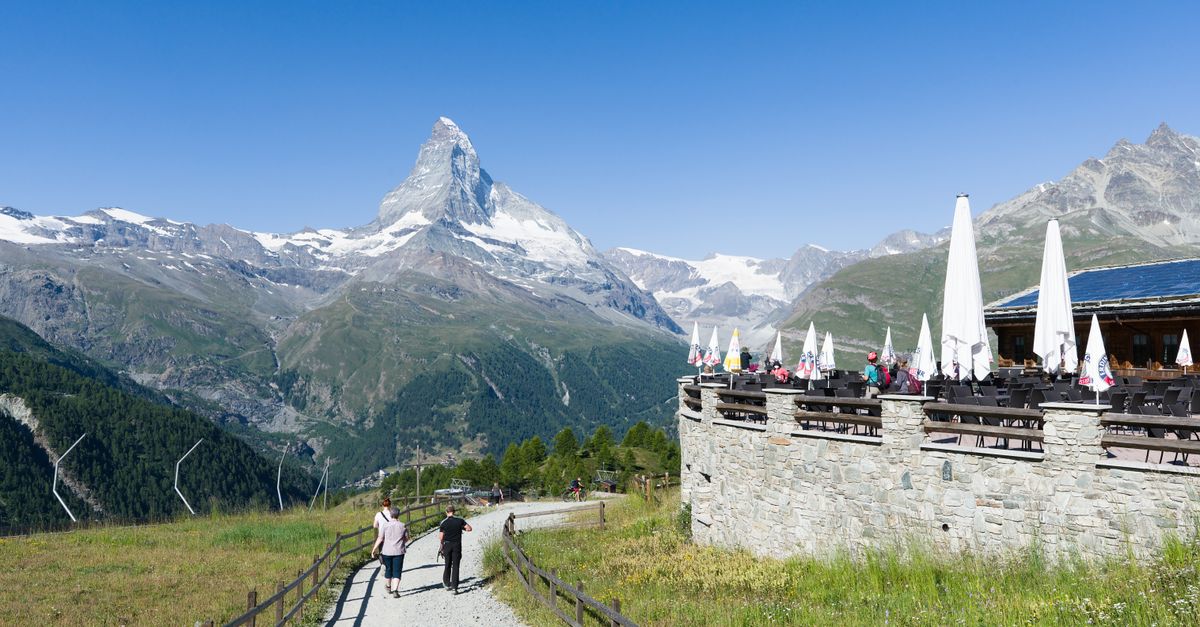
Zermatt, Switzerland: a car-free mountain village at the foot of the Matterhorn — the most famous peak in the Alps — in the canton of Valais, in the south of the country. No cars, no through traffic, just electric buggies, horse-drawn carriages, and footpaths between wooden chalets, with the Matterhorn filling the sky at the end of the main street. It is a ski resort, a hiking base, and a viewpoint all at once: the Gornergrat railway climbs to a 360-degree panorama, cable cars reach the Klein Matterhorn glacier at 3,883 m, and the Five Lakes Walk strings alpine lakes together beneath the peak. Come for the mountain, stay for the quiet.
In this guide
- The short version
- Quick facts
- Your first hour, minute by minute
- Your first evening
- Your first full day
- Where to stay your first nights
- Where to eat first
- Getting around
- Do this, skip that
- Day trips and beyond
- If you stay longer
- When to go and what it costs
- What to pack
- Language, visa and entry
- Related destinations
- Tours & Experiences
Zermatt, Switzerland: a car-free mountain village at the foot of the Matterhorn — the most famous peak in the Alps — in the canton of Valais, in the south of the country. No cars, no through traffic, just electric buggies, horse-drawn carriages, and footpaths between wooden chalets, with the Matterhorn filling the sky at the end of the main street.
Quick facts
Your first hour, minute by minute
Arrive at Zermatt station
Rail passengers ride all the way in; if you drove, leave the car at Täsch and take the shuttle train. Step out of the station and look up — on a clear day the Matterhorn is straight ahead.
Let your hotel collect you
Many hotels pick guests up from the station by electric buggy — confirm this when you book. Otherwise take an electric taxi; the village is compact, but bags and altitude make the first walk harder than it looks.
Drop bags and check lift status
Ask at the hotel or the station for today's lift openings, weather, and any closures — mountain plans depend on conditions, not on the calendar.
Walk Bahnhofstrasse to the church bridge
The main street runs from the station through the village; the bridge by the parish church is the classic first Matterhorn photo.
Get your bearings in the old village
Behind the main street, the Hinterdorf quarter keeps Zermatt's dark timber barns and granaries — a five-minute detour that shows what the village was before tourism.
Your first evening

An easy evening — a stroll up Bahnhofstrasse, a look at the Matterhorn glowing pink at sunset, then dinner: fondue is the first-night rite, a pot of melted cheese with bread, followed by a walk back through the quiet, car-free streets. Early night if the Gornergrat railway is tomorrow's plan.
Your first full day

Morning:
Gornergrat Railway — the cogwheel train climbs from the village station in about half an hour to Gornergrat at 3,089 m, with a 360-degree panorama over 29 four-thousand-metre peaks, including Monte Rosa. From Rotenboden, one stop below the summit, a short trail leads to the Riffelsee, the lake of the classic Matterhorn reflection photo — go early for still water. Afternoon: Sunnegga and the Five Lakes Walk — ride the funicular to Sunnegga, then walk the Blauherd–Sunnegga trail past the Stellisee, Grindjisee, Grünsee, Moosjisee, and Leisee (about 9.8 km, roughly two and a half hours, mostly downhill). On a calm day the Matterhorn mirrors in the Stellisee. Evening: The Matterhorn Museum in the village, which tells the story of the peak's first ascent in 1865, then dinner in town.
Where to stay your first nights
The Omnia.
A design hotel at Triftweg 40, above the village, with Matterhorn views, a spa, and station pickup by electric buggy. Best if you want the most polished, design-led stay in Zermatt.
Grand Hotel Zermatterhof.
A five-star hotel on the main street at Bahnhofstrasse 55, in business since 1879, with a spa and restaurants. Best if you want grand-hotel atmosphere in the centre of the village.
Hotel Bahnhof.
A budget hotel and hostel directly opposite the station at Bahnhofplatz 54, in business since 1902, with private rooms and dorms, shared and private bathrooms, and a common kitchen. Best if you want the cheapest real bed in the village and a two-minute walk to the trains.

Stay in the village for walking access to the station, lifts, and restaurants — Zermatt is compact, and every part of it is within walking distance of the main street. All three picks below are real, operating properties.
Where to eat first
Fondue.
Melted cheese with bread for dipping — the dish to order on your first night. Half-and-half Gruyère and Vacherin is the classic mix.
Raclette.
Melted cheese scraped over potatoes, pickles, and cured meats — the other great Valais cheese ritual.
Rösti.
Crisp grated-potato cake, served as a side or topped with egg and cheese — mountain fuel.
Valais wines.
The canton of Valais produces Fendant (a dry white) and Dôle (a red blend) — order local by the glass.
Mountain restaurants.
Lunch on a sunny terrace above the village is half the point of Zermatt — mountain restaurants such as Chez Vrony above Findeln serve Valais dishes with Matterhorn views. Book ahead in peak season.
Rivella and chocolate.
Rivella, the Swiss whey-based soft drink, and a bar of Swiss chocolate are the low-effort souvenirs.
Getting around
Times are airport to city centre.
Matterhorn Gotthard Bahn
Täsch shuttle train
Electric taxi
Hotel buggy
Gornergrat Railway
Sunnegga funicular
Matterhorn Express gondola
Horse-drawn carriage
Walk
The village is flat enough to walk, and the lifts do the vertical work. In winter, check lift and piste status each morning — wind and avalanche risk close lifts without warning.
Do this, skip that
✓ Do this
Ride the Gornergrat Railway early for the clearest light. Walk at least part of the Five Lakes trail for the Stellisee reflection. Visit the Matterhorn Museum. Layers, sunglasses, and strong sunscreen — the sun at altitude is fierce even on cool days. Book mountain restaurants ahead in peak season. Carry your passport or ID if you plan to cross into Italy. Drink water and take lifts slowly at 3,883 m — the air up there is thin.
✕ Skip that
Trying to drive into Zermatt — private cars are not allowed; park at Täsch. Treating the Matterhorn as a casual hike — it is a serious technical climb for experienced alpinists with guides only. Expecting budget prices — Zermatt is one of the priciest mountain towns in Europe. Rushing it in a single day — the mountain hides in cloud, and a second day doubles your chance of the classic view.
Day trips and beyond

Matterhorn Glacier Paradise.
The cable car from the village via Schwarzsee reaches Klein Matterhorn at 3,883 m — the highest cable car station in Europe — with an ice palace carved into the glacier and, on clear days, views across to Mont Blanc. Year-round snow; skiing is possible here even in summer.
Cervinia, Italy.
From Glacier Paradise you can ski or ride across the border into Breuil-Cervinia, the Italian resort on the other side of the Matterhorn — lunch in Italy, back in Switzerland by lift. The Matterhorn Alpine Crossing links the two sides by cable car. Carry ID for the border crossing.
Gorner Gorge.
A wooden walkway threads a narrow gorge just outside the village — a short, easy detour on a rest day, with waterfalls and polished rock walls.
Glacier Express to St. Moritz.
The famous panoramic train runs from Zermatt to St. Moritz (in the canton of Graubünden), crossing 291 bridges and 91 tunnels and the Oberalp Pass at 2,033 m. A full-day journey — reserve seats ahead; it is a scenic trip, not a quick transfer.
If you stay longer

Day two: Matterhorn Glacier Paradise and the ice palace in the morning, then the Gorner Gorge and the Hinterdorf old village in the afternoon. Day three: the full Five Lakes Walk, or the harder Hörnli Hut trail from Schwarzsee to the hut at the foot of the Matterhorn's Hörnli ridge (about 4.3 km each way with steep, exposed sections — only for sure-footed hikers with good conditions). With a week, add a ski day across to Cervinia, the Glacier Express to St. Moritz, and a guided 4,000 m peak or glacier walk — Zermatt's guides run these all summer.
When to go and what it costs
What to pack
Tap items to check them off — your list is saved on this device.
- Layers: base, insulation, and a windproof, waterproof shell — mountain weather turns fast in every season
- Sturdy walking shoes or hiking boots with grip; ski boots if you are skiing (gear is rentable in the village) Shop walking shoes on Amazon →
- Sunglasses, high-SPF sunscreen, and lip balm — glacier sun is strong even in winter Shop sunscreen on Amazon →
- Swimwear for hotel spas and pools
- A small daypack, water bottle, and snacks for trail days Shop water bottle on Amazon →
- Type C/J plug adapter for Swiss sockets Shop adapter on Amazon →
- Passport or ID for the Italy crossing; travel insurance that covers mountain rescue
Language, visa and entry
✓ Visa-free entry
- Language: German — "Danke" (thank you), "Bitte" (please), "Grüezi" (hello, in Swiss German). French and Italian are also national languages; English is widely spoken in tourism.
- Visa: Schengen — many nationalities enter visa-free for up to 90 days in any 180-day period. Check the current rules for your passport before booking.
- Money: Swiss francs (CHF) for lift tickets, mountain huts, and small shops. Cards work at most hotels and larger restaurants.
- Emergency: 117 (police), 118 (fire), 144 (ambulance), 112 (European emergency number), 1414 (Rega mountain rescue).
Affiliate disclosure: hotel names, transfers, experiences, and products linked in this guide may earn After You Land a commission at no extra cost to you. Prices and times were checked in Oct 2026 and change often — confirm before you book.