Fes: your first hour after landing
You have just landed south of Fes, bound for a medina no car can enter — the last stretch is a grand taxi to a tiled gate, then a porter, a lane and a courtyard door. This guide covers the airport run and its fixed fares, where to sleep from palace riad to Batha hostel, what to eat first, a first day from Bab Bou Jeloud to the tanneries, and the ruins, cedar forest and blue town that fill days two and three.
In this guide
You just landed in Fes. The airport sits about 15 km south of a car-free medina — the move is a fixed-fare grand taxi, 120 to 150 MAD to your gate, with a Saily eSIM live from arrivals, a porter booked through your riad for the last lanes, and the guided medina morning and the day trips that sell out first worth booking ahead through GetYourGuide.
Quick facts
Airport
Getting in
Currency
Languages
Time zone
Emergency
Plugs
Tap water
Tourist tax
Best months
Map
Stays, sights, and landmarks in Fes — live hotel prices plus the key places from this guide.
Settle in
Land at Fès-Saïs and do the slow parts first: passport control stamps you in — check the stamp before you leave the desk — then find the ATMs in arrivals, because the dirham is a closed currency and your first taxi and porter want cash.
Set up data before you leave the terminal: a Yesim eSIM loads a Morocco plan in minutes, so maps and riad messages work from the kerb. Comparing plans, check Saily and Airalo.
Run the arrival checklist in this order:
- Withdraw dirhams in arrivals — small notes for the taxi, the bus and a porter tip
- Message your riad and agree the meeting gate — Bab Bou Jeloud, Rcif or Batha — because no car enters Fes el Bali
- Ride a fixed-fare grand taxi to that gate (120 to 150 MAD), or take bus 16 to the train station if you are travelling light
Check the tax line when the riad quotes your rate: two taxes ride on top — the taxe de séjour, by property category, plus the tourism promotion tax — together roughly 3 MAD a night in a hostel, up to about 45 MAD at a luxury riad, per person, in cash at checkout.
If a delayed or cancelled flight wrecked the arrival, AirHelp checks whether the airline owes you compensation — worth five minutes.
Getting around

Times are airport to city centre.
Bus 16
Runs from the stop outside the terminal to Gare de Fès train station, roughly hourly in daytime only and erratic; a petit taxi covers the last stretch to a medina gate
Grand taxi
Fixed fare by drop point, agreed before you get in: about 120 MAD to the Ville Nouvelle and station, about 150 MAD to a medina gate; the rank is outside arrivals
Pre-booked transfer
Book ahead or ask your riad to send a car; the driver meets you in arrivals and a porter takes bags onward from the gate — the low-stress option for late flights
Rental car
Worth it only for Middle Atlas and regional touring; the medina is car-free, so park in the Ville Nouvelle or at a gate car park and walk in

Fès-Saïs sits about 15 km south of the city. With a suitcase, the fixed-fare grand taxi outside arrivals is the honest default: about 120 MAD to the Ville Nouvelle, about 150 MAD to a medina gate, agreed before you get in. Travelling light, bus 16 runs to Gare de Fès in about 40 minutes — roughly hourly, daytime only, too erratic for a tight departure. The airport rides are these:
Inside Fes el Bali you walk — that is the whole transport system. Its 9,000-plus alleys are car-free, stepped and steep, and goods move by handcart and donkey (listen for "balak", coming through). Around the walls, red petit taxis run on the meter between gates, Batha, the station and the Ville Nouvelle: insist the meter is on. ONCF trains cover the region — Meknes in about 40 minutes.
Prefer to be met? A Kiwitaxi transfer or a Welcome Pickups driver puts a name board in arrivals — worth it for a late flight or a deep-medina riad. Driving yourself, price the pickup on AutoEurope first, and park outside the walls.
In the city
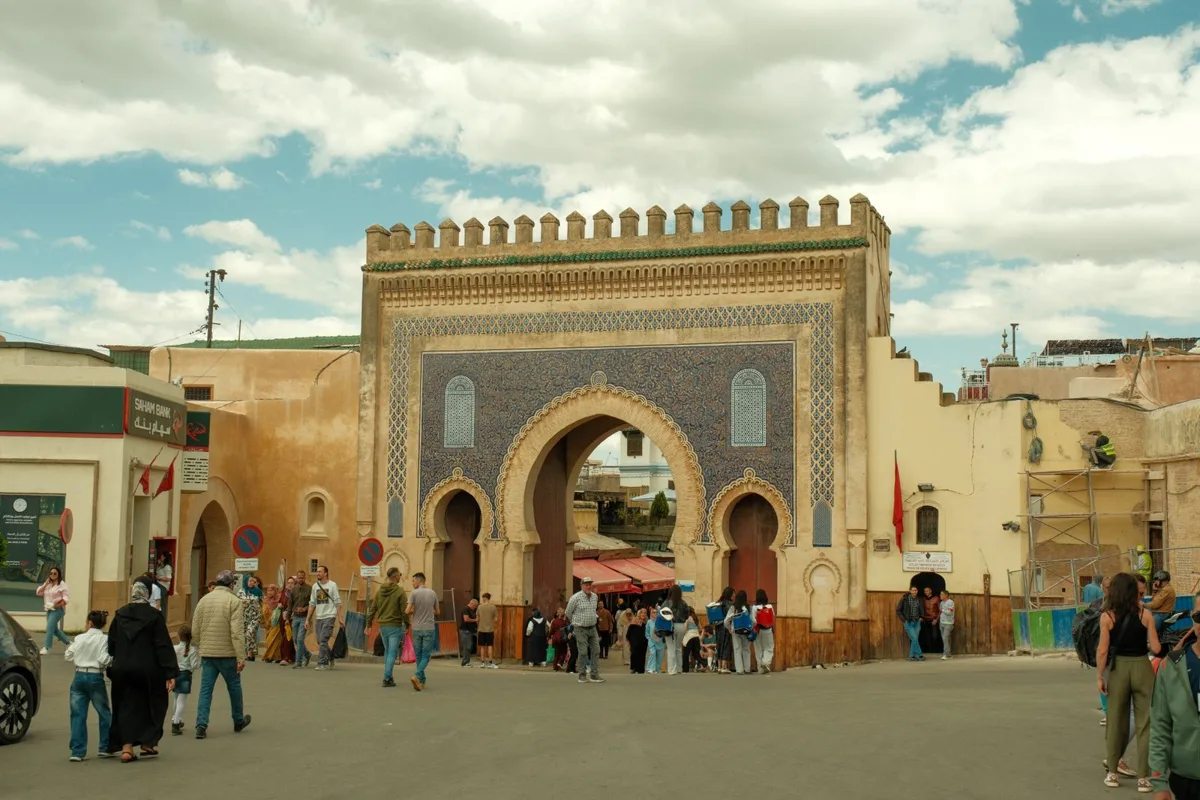
Start at Bab Bou Jeloud, the blue-and-green tiled gate, and walk downhill on Talaa Kebira. Visit the Bou Inania Madrasa first — the great 14th-century school, one of the few in Morocco visitors may enter — then the Nejjarine Museum, in a restored caravanserai around its fountain square.
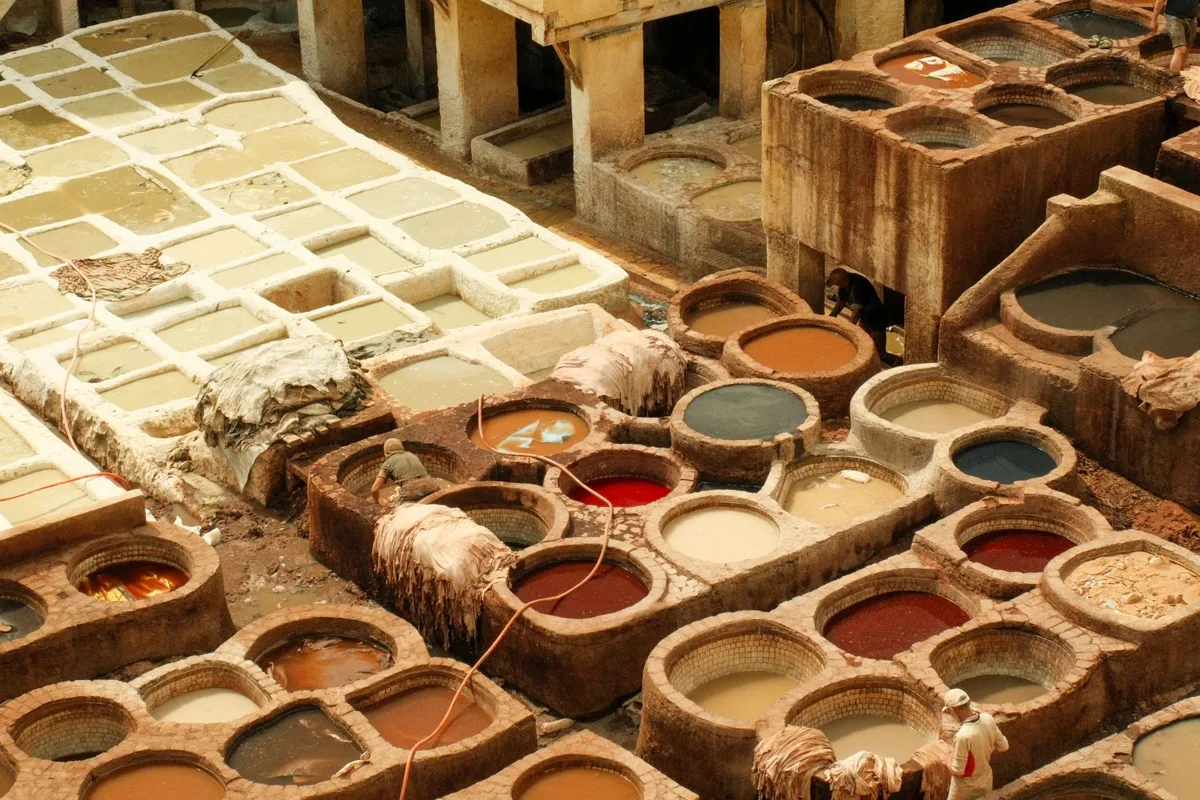
Peek through the doors of Al-Qarawiyyin, founded in 859 and recognised as the world's oldest continuously operating university: non-Muslims cannot enter, so take the view from the thresholds. Cross Seffarine Square, loud with coppersmiths, and finish at the Chouara Tannery, from a leather-shop terrace — take the mint sprig, and know the terraces belong to shops hoping you will browse.
Book an official guide for the first morning: the medina's logic — souks grouped by trade, two Talaas that both slope home — clicks far faster with one. Browse the Fes listings on GetYourGuide.
Give the late afternoon to the view: climb to the Merenid Tombs for sunset over the medina, then walk down through the Jnan Sbil gardens and end in Fes el-Jdid at the Royal Palace's golden gates — photographed from outside, as far as any visitor gets.
After you land in Fes: Bookable experiences
Where to stay your first nights

Riad Fès - Relais & Châteaux.
Best for the grand medina splurge, with pool and spaThe medina's grand address at 5 Derb Ben Slimane Zerbtana: a restored palace of 30 rooms around Andalusian and baroque patios, with an outdoor pool, spa and hammam, the Gayza restaurant and a rooftop over the medina. Bell staff meet you at the drop point and port the bags in.

Barceló Fès Medina.
Best for a low-friction four-star base in the Ville NouvelleA calm four-star in the Ville Nouvelle at 53 Avenue Hassan II: 148 rooms remodelled in 2024, a pool, spa and hammam, and the Borj Fes mall next door. Taxis stop at the door — the low-friction base.

Riad Verus.
Best for budget dorms and privates at the Batha edgeAn adults-only hostel in a restored riad at 1 Derb Arset Bennis, Batha: ensuite dorms and privates, breakfast included, family dinners and a roof terrace facing the Merenid Tombs. Batha is the medina's easiest edge for bags, with taxis and parking close.
Choose your base by luggage, not just by romance. A riad inside Fes el Bali means a porter, stepped lanes and no car at the door — easiest at the Batha edge (Bab Bou Jeloud side) or near Rcif, where vehicles stop. The Ville Nouvelle swaps atmosphere for lifts, parking and a taxi at the kerb.
Book early for April, May and October, and confirm whether the total includes both tourist taxes.
Where to eat first
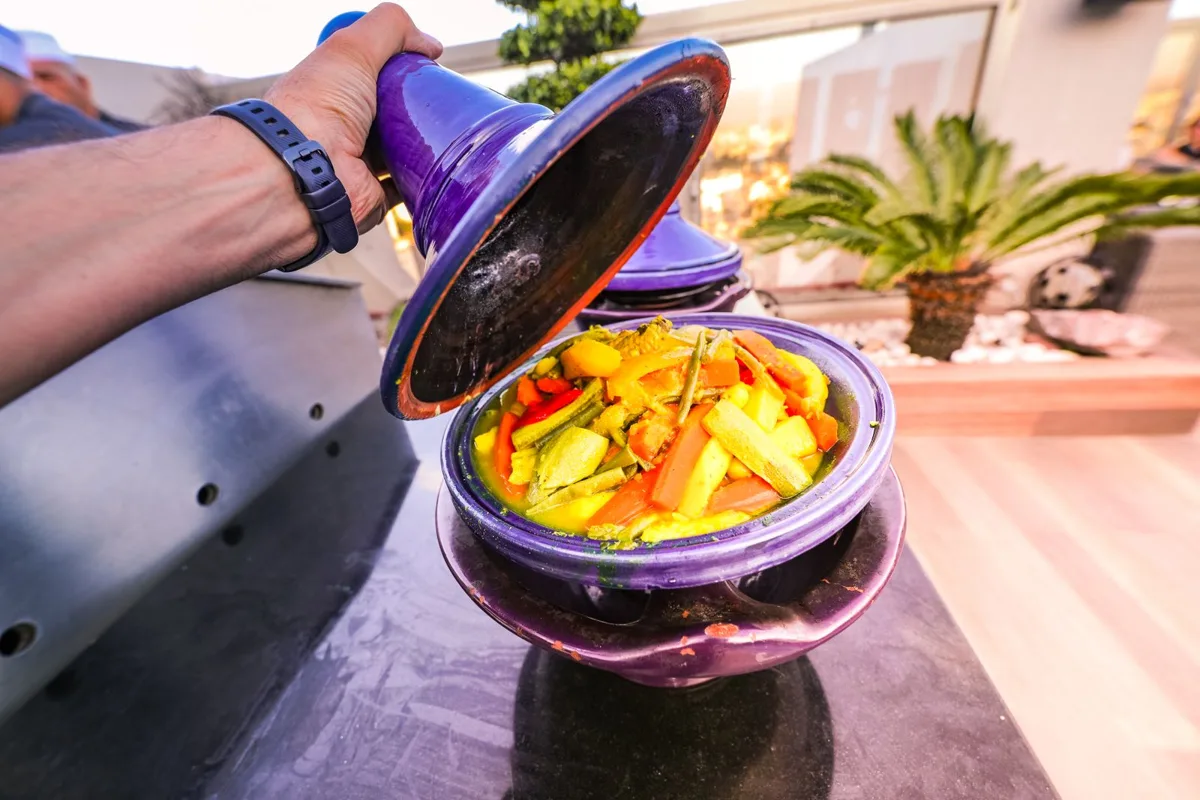
Eat Fassi on day one — Fes claims Morocco's most refined kitchen, built on pastilla (the sweet-savoury pigeon or chicken pie), slow tagines, harira and bissara, the fava-bean soup of the lanes. Three first stops:
Café Clock.
The cross-cultural café at 7 Derb El Magana, off Talaa Kebira below Bab Bou Jeloud. Order the camel burger, take the rooftop for the view, and check the board for music nights and cooking classes.
The Ruined Garden.
A garden restaurant in a ruined courtyard house at 15 Derb Idrissy, Sidi Ahmed Chaoui, near Batha. Book ahead, ask about the seven-hour mechoui lamb, and expect juices and mint tea — no alcohol.
The stalls at Bab Bou Jeloud.
Breakfast where the medina does: bissara with olive oil and cumin, msemen off the griddle, fresh orange juice. Eat at the busiest stall, pay in small notes, then take mint tea overlooking the gate.
For souk food walks and a pastilla cooking class, browse the Fes listings on GetYourGuide.
Day trips and more
Three escapes run from the gates — west to Roman ruins, south into the cool Middle Atlas, north to the blue town — all bookable on GetYourGuide.

Volubilis, Moulay Idriss and Meknes day trip
Nine hours with hotel pickup: walk the mosaics and Arch of Caracalla at Volubilis, climb the hill town of Moulay Idriss for the panorama, then finish in Meknes at Bab Mansour and the mausoleum of Moulay Ismail. Entry fees and lunch are on you. Check availability →

Middle Atlas day trip with Ifrane National Park
A cooler escape south: Immouzar's cave houses, alpine-looking Ifrane and its stone lion, the cedar forest's Barbary macaques, then Azrou market town and tea with a family in a cave house. Lunch is not included. Check availability →
Chefchaouen day trip, the Blue Pearl
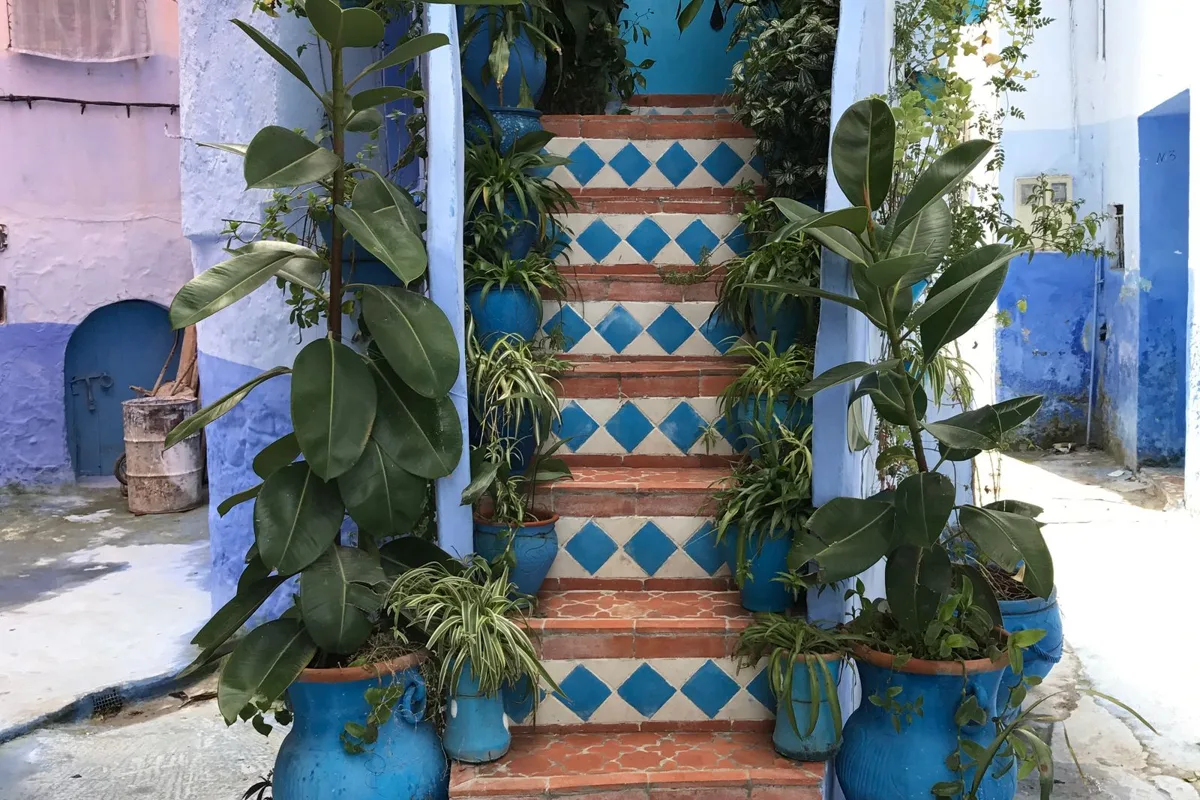
About four hours each way through the Rif (some 200 km) buys roughly four hours among the blue-washed lanes and the kasbah. It works as a taster, returning between 20:00 and 21:00; if the blue town is a priority, sleep there instead. Check availability →
When to go and what it costs

April, May, September and October are the sweet spot: lanes in the low-to-mid 20s, day trips comfortable. July and August are the furnace months — highs around 35°C, spikes past 40°C, sightseeing only before 11:00 and after 17:00. Winter days sit around 15 to 17°C with rain, and unheated riad rooms feel colder than the forecast: pack layers.
A backpacker in a dorm, on bissara breakfasts and market lunches: 300 to 450 MAD a day. Mid-range — a four-star or good riad room, sit-down dinners, a guided morning: 900 to 1,400 MAD a day. A splurge day at the grand riad passes 2,500 MAD without trying.
Carry cash: entries, petit taxis, porters, market food and both taxes are dirham territory, and medina ATMs empty on festival weekends.
What to pack
Tap items to check them off — your list is saved on this device.
Pack for hills and sun — lanes are stepped, cobbled and steep, and your suitcase may ride a porter's cart. This is the full list:
- Comfortable walking shoes Shop walking shoes on Amazon →
- Sunscreen Shop sunscreen on Amazon →
- Reusable water bottle Shop water bottle on Amazon →
- Phone charger and power bank Shop power bank on Amazon →
- Daypack Shop daypack on Amazon →
- Sunglasses Shop sunglasses on Amazon →
- Light rain jacket Shop rain jacket on Amazon →
Add the Fes extras: a zipped bag worn in front in the souks, a light scarf for shoulders at religious sites, and a phone light for unlit lanes. Download an offline map before you land, and expect the medina to defeat it — that is normal.
Language, visa and entry
✓ Visa-free entry
Darija first, French second — that order opens doors in Fes. Greet before you ask anything: salam alaikum in every shop and taxi, shukran for every kindness. Haggling is expected and good-humoured: offer well under the first price, meet in the middle, walk away only if you mean it. Dress modestly — covered shoulders and knees read as respect, above all near mosques.
Four phrases do most of the work:
Sort entry paperwork before you book anything non-refundable. Morocco is not Schengen: visitors from the US, UK, EU, Canada, Australia and many other countries enter visa-free for up to 90 days, stamped on arrival — check the stamp lands, as travellers without one have had trouble leaving. Carry a passport in good condition with six months of validity: some guidance asks three months beyond arrival, airlines ask six, and six is the safe target.
Travellers whose nationality is not visa-exempt use Morocco's e-visa platform Acces-Maroc or a consulate before travel. Extensions are requested at a police station, well before the stay runs out. The visa-free stay covers tourism, not work.
Safety and health
Unofficial guides are the medina's main nuisance
Men and boys at gates offer directions, insist your street is closed, or walk you — unasked — to a shop, then expect payment. Decline with a smile and la, shukran, keep walking, and hire only official guides, who carry a badge, through your riad or a booked tour.
Tannery terraces come with a sales pitch
The Chouara view is free from the shop terraces, the mint is a courtesy against the smell, and a look at the leather afterwards is the understood exchange — but you owe no purchase, and pressure to buy is your cue to leave calmly. Agree any price before goods change hands.
Keep city instincts in the crowds
The Talaas are dense: bag zipped and in front, phone out of sight at café edges, bags to registered porters at the gates. In petit taxis insist on the meter; in grand taxis agree the fare first.
Heat and stomachs are the real health risks
Summer sightseeing means shade breaks and steady water — bottled or refilled, since tap-rinsed salads upset some visitors — plus a hat for Volubilis. Pharmacies (green-cross signs) handle minor trouble; for anything serious, ask your riad to call a doctor, and carry insurance.
Related destinations
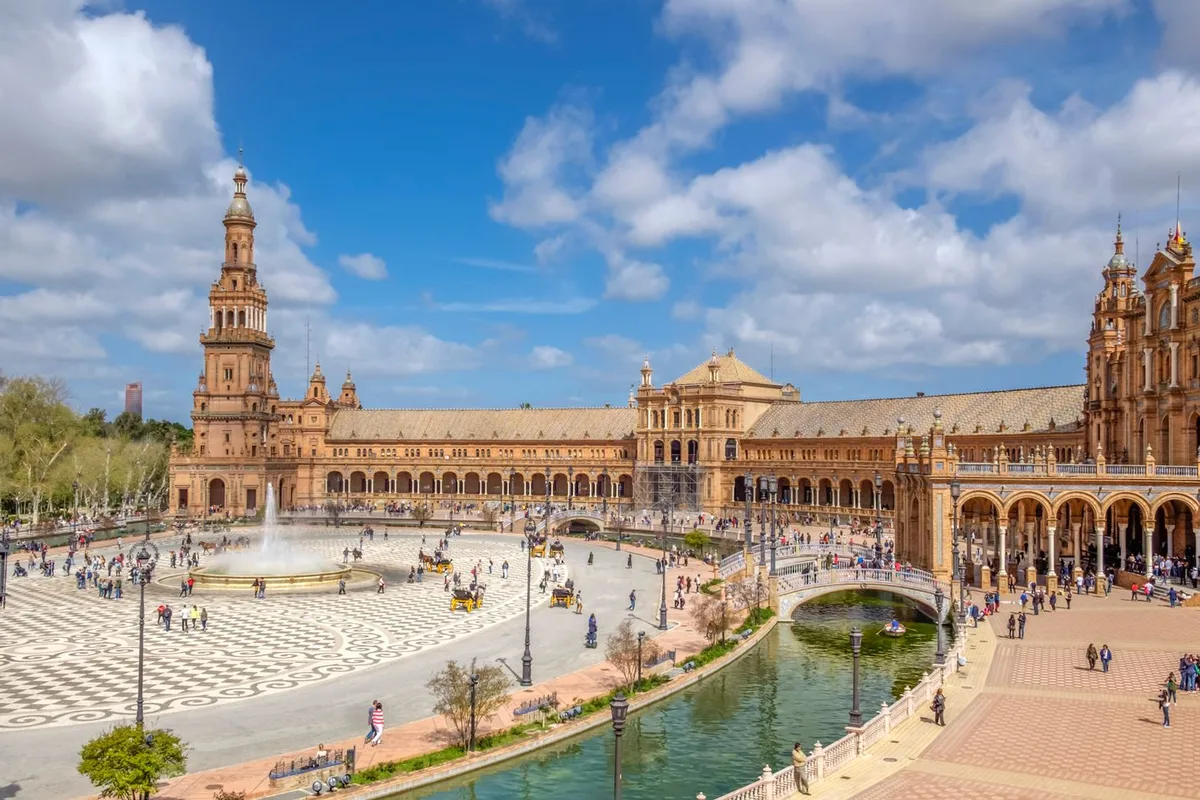
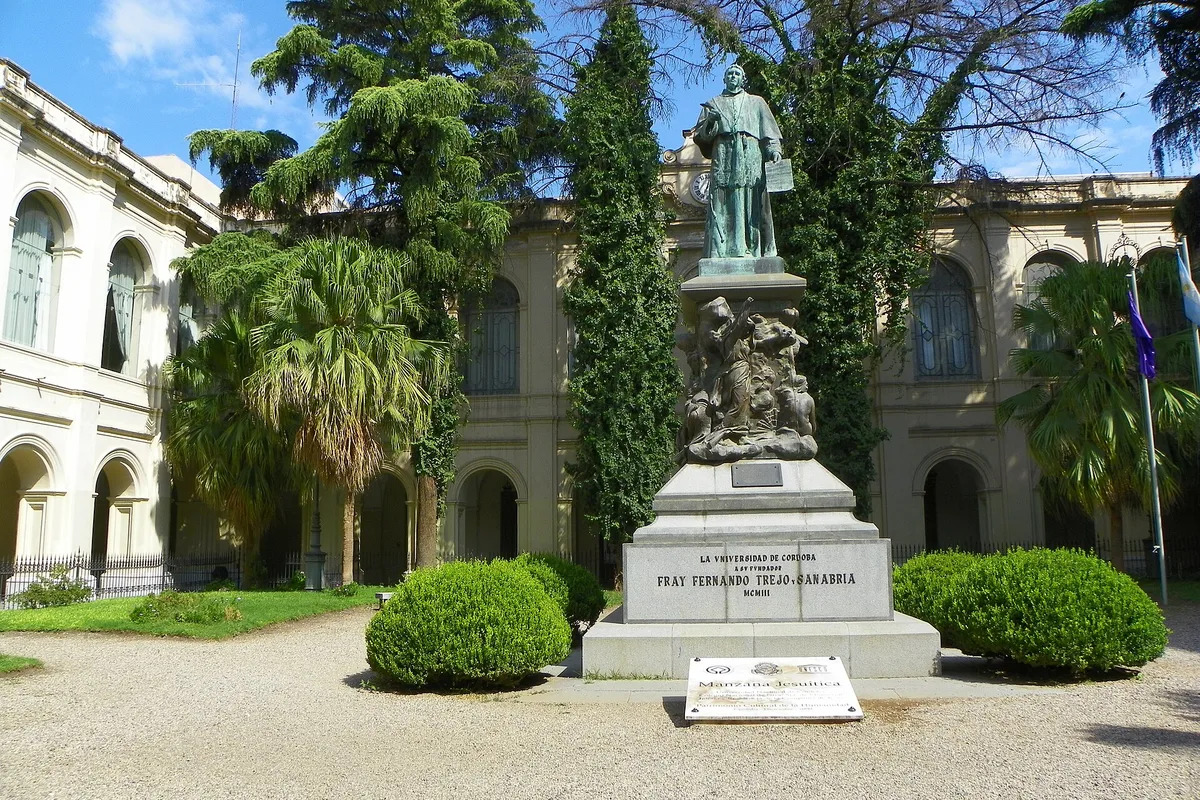
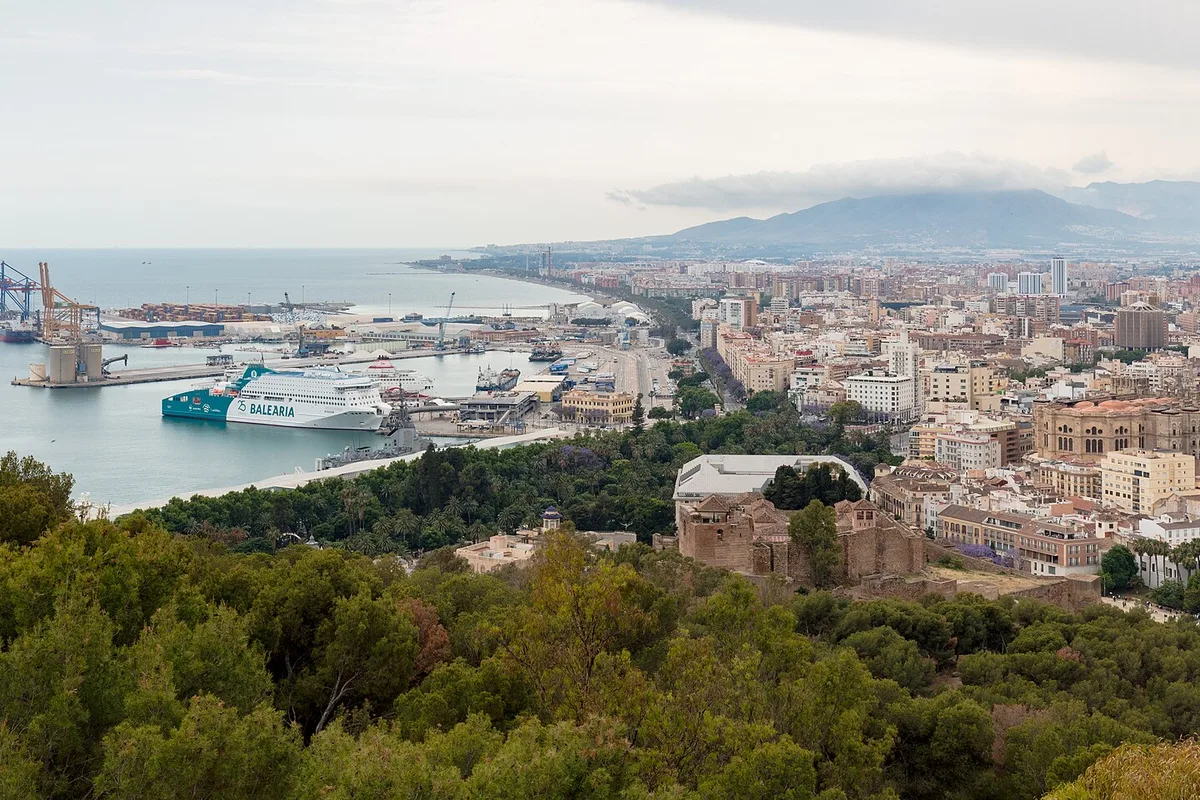
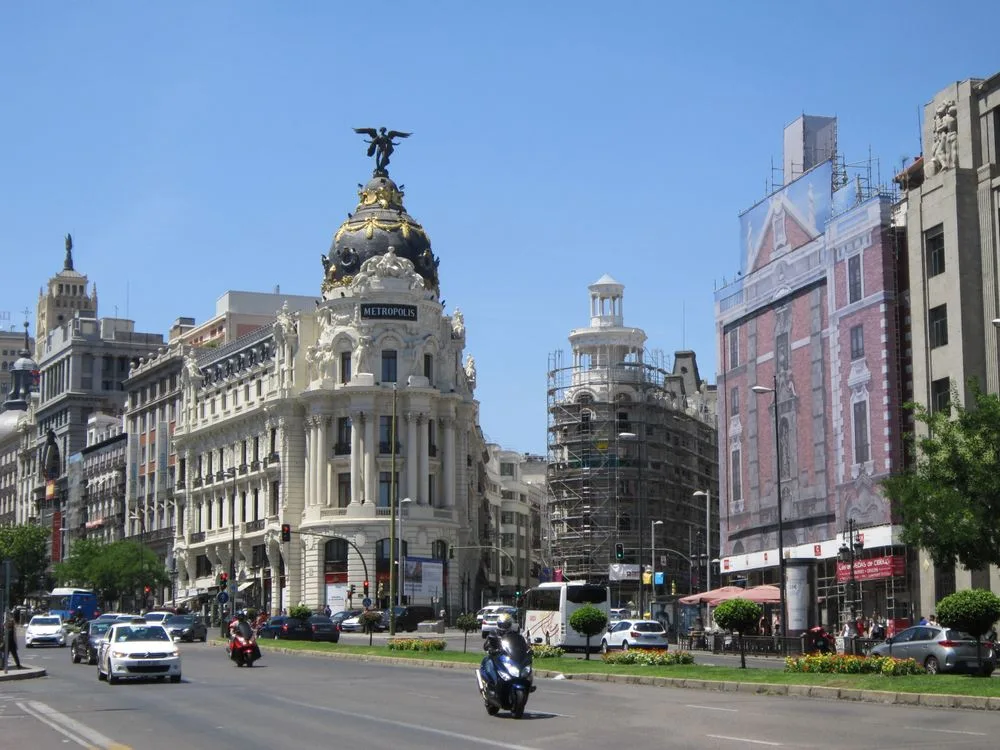
If you liked Fes, try these next:





Frequently asked questions
The things travellers ask in the first 48 hours: the gate your taxi stops at, the porter with your bags and the two taxes on the bill.
Transfers checked against airport and city transport guides and Welcome Pickups, taxes against Law 47-06 bands and the TPT decree, entry rules against UK, Canadian and Irish travel advice, October 2026.
Take a fixed-fare grand taxi outside arrivals: about 120 MAD to the Ville Nouvelle and station, about 150 MAD to a medina gate, agreed before you get in, around 30 minutes. Travelling light, bus 16 runs to Gare de Fès for 20 MAD in about 40 minutes, roughly hourly in daytime.
No car enters Fes el Bali. Your taxi drops you at the nearest gate (Bab Bou Jeloud, Rcif or Batha), and a porter, usually arranged by your riad, wheels your bags through the lanes. Message the riad before you land and agree the gate.
For most visitors, no. US, UK, EU, Canadian and Australian passport holders are among those stamped in visa-free for up to 90 days. Check your passport was stamped, and carry at least six months of validity — guidance splits between three and six months, and six is the safe target.
April, May, September and October: warm lanes and comfortable day trips. July and August average highs around 35°C and can pass 40°C, so sightseeing shrinks to mornings and evenings. Winter days are mild but riad rooms feel cold at night.
Two taxes combine: the taxe de séjour, set by property category, and the tourism promotion tax (TPT). Together they run from roughly 3 MAD per person per night in a hostel to about 45 MAD at a luxury riad, usually in cash at checkout.
For a first morning, yes — an official guide, who carries a badge, makes the souk-by-trade layout click and ends the unofficial-guide hassle. Book through your riad or a rated tour; decline unasked guiding at the gates with a smile and la, shukran.
Fares change — the rank, your riad and the station always win.
Fes, in your pocket
Landing soon? Get the printable PDF — ticket links, the airport transport cheat sheet, our 3 restaurant picks with maps, and the packing checklist. Everything above, formatted for your phone.
One email with your Fes PDF. Fare changes and new guides after that. No spam, unsubscribe anytime.
Sources and last verified
Airport transfers against airport and city transport guides and Welcome Pickups: grand taxi fares print at 120 MAD to the city in some sources and 150 MAD to the medina in others, so the guide prints both by drop point. Bus 16 prints at 20 MAD in current arrival guides, Orbitz and the Funky Fes directions, against 4 MAD in older guides; the guide prints 20 MAD and flags the conflict here. Tourist taxes against the Law 47-06 bands and the TPT decree rates (15 MAD luxury down to 1 MAD hostels), combined into the printed range, as Fes publishes no single figure. Time zone against timeanddate and Morocco World News on the 20 September 2026 GMT decree. Entry against UK, Canadian and Irish advice, October 2026: visa-free 90 days, stamp required, validity guidance split three to six months, so six is printed. Hotels against Expedia listings opened October 2026 and their own sites; Riad Verus's Expedia page was not confirmed in this pass, so it carries no Expedia link in the guide data. Day trips against the three GetYourGuide product pages opened October 2026. Photo credits as in the guide data. Last verified October 2026.
Affiliate disclosure: hotel names, transfers, experiences, and products linked in this guide may earn After You Land a commission at no extra cost to you. Prices and times were checked in Oct 2026 and change often — confirm before you book.