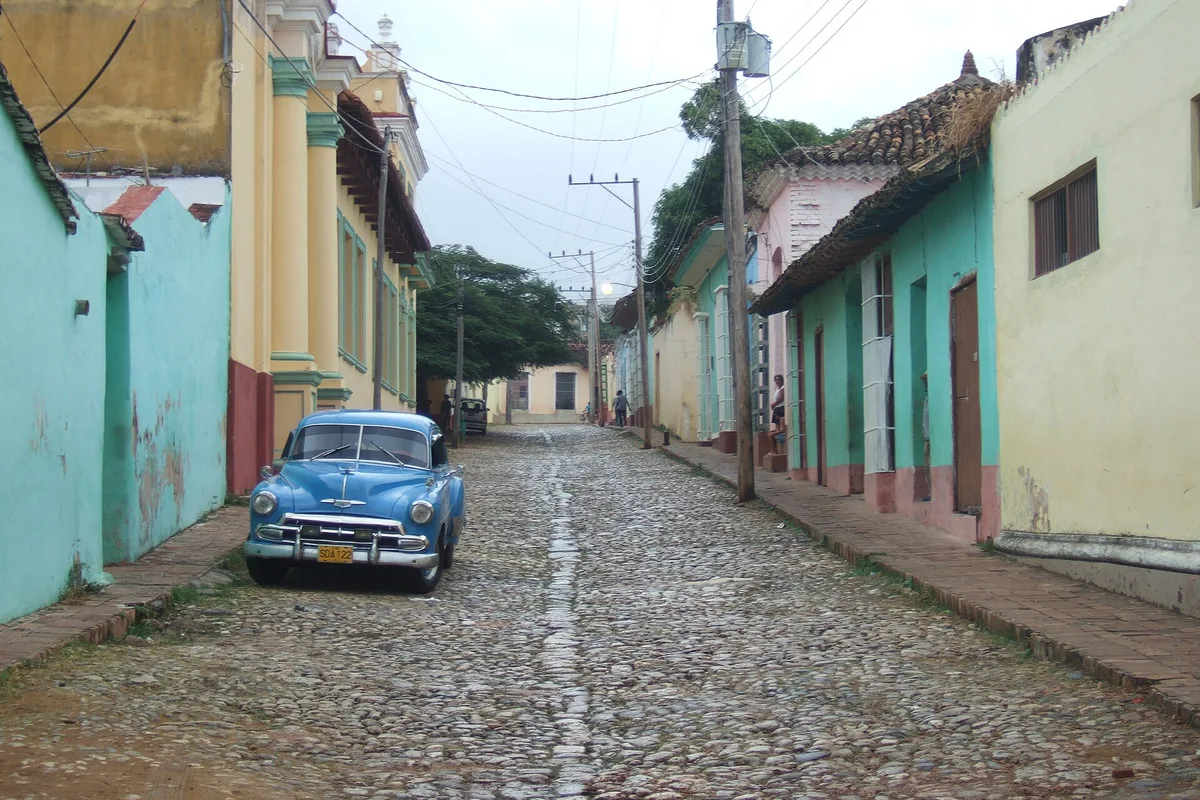
You have just landed — by road. Trinidad has no airport: the last leg is a coach or a car from Santa Clara, Cienfuegos or Havana, ending on cobbles in one of the best-preserved colonial towns in the Americas, founded in 1514 and rich on sugar. What waits is a UNESCO-listed old town of pastel mansions and music steps, a white-sand beach 12 km south, a sugar valley and waterfalls either side, and a cash-only economy that rewards travellers who arrive with paperwork done and dollars in hand. This guide walks the arrival in order — the gateways, the paperwork and the cash, where to sleep, the first paladar, the days out, and the US rules.
By Paul GreenUpdated Oct 202612 min readPrices checked Oct 2026
You just landed in Trinidad. There is no airport here — the landing is a road, so do the paperwork first: eVisa online, D'Viajeros QR printed, and your whole budget in clean cash, because cards will not save you here. Arrange Viazul coach seats for the ride in before you fly, have your host send a car if coach times strand you, and if the flight itself went wrong, AirHelp can check your compensation. Then change money through your host, never a street changer.
Quick facts
Airport
No airport in Trinidad itself nearest Abel Santamaría (SNU) at Santa Clara, about 110 km north — Cienfuegos (CFG) is about 85 km west; Havana (HAV) about 330 km by road. Trinidad's own TND strip has no regular flights.
Getting in
A Viazul coach or a shared or private taxi from your gateway city Havana is about 6 hours by coach, Santa Clara about 2 to 2.5 hours. Book coach seats online; agree taxi fares before you ride.
Currency
The Cuban peso (CUP) is the only currency and cash is the whole plan — Bring your full budget in clean dollar or euro notes. US cards never work; Visa and Mastercard processing was suspended in June 2026.
Languages
Spanish runs Trinidad; English works in casas, paladares and with tour drivers Taxis and markets run on Spanish; the phrase chips below cover the essentials.
Time zone
Cuba Time (UTC−5), with daylight saving (UTC−4) through the summer months Trinidad keeps the same time as Miami for most of the year.
Emergency
106 for police, 104 for ambulance, 105 for fire Operators speak Spanish — your casa host can call with you.
Plugs
Type A and B sockets at 110 volts are the standard the flat US-style pins — Some hotels also wire 220-volt Type C and L. Check first.
Tap water
Do not drink it bottled water is the rule everywhere — Drink agua embotellada; casas supply it cheaply.
Tourist tax
No per-night hotel tax, and nothing to pay when you leave The old departure tax is folded into ticket prices; your up-front cost is the eVisa, about US$50.
Best months
November to April for dry, warm days outside hurricane season June to November is hurricane season, peaking from August to October.
Map
Find your arrival stop, hotel, and first meal. Stays, sights, and landmarks in Trinidad, Cuba — live hotel prices plus the key places from this guide.
Trinidad has no airport: landing here means a flight into Santa Clara, Cienfuegos or Havana, then a road leg — paperwork and cash are step one.
Sort connectivity before you leave home. Travel eSIMs do not sell Cuba plans, so the working setup is ETECSA's Cubacel Tur tourist SIM — ordered online or bought at the airport desk — plus offline maps: data is patchy.
Run the arrival checklist in this order:
Print the eVisa approval and D'Viajeros QR, with screenshots on your phone
Carry your whole trip budget in cash — clean dollar or euro bills, small denominations
Book the Viazul coach or have your casa host send a driver
Agree every fare before you ride, and write out your casa's address with its cross-streets — drivers navigate by them.
If the flight itself went wrong, AirHelp checks whether the airline owes you compensation.
Getting around
Journey times are approximate and refer to the listed stop — not necessarily your hotel. Allow extra time for waiting, walking, and connections.
Viazul coach from Havana
Book at viazul.wetranssa.com before you fly: 1 to 2 coaches a day via Cienfuegos, and the route sells out in season; arrive at Havana's national bus terminal an hour ahead
Priceabout US$25Journeyabout 6 hours
Viazul coach from Santa Clara
The cheapest leg for Santa Clara (SNU) arrivals — but through-coaches start in Varadero or Havana, so seats onward to Trinidad are limited; book early or fall back on a colectivo
Priceabout US$6Journeyabout 2.5 hours
Colectivo (shared taxi) from Santa Clara
Shared cars leave when full from near Santa Clara's bus terminal, about 1.5 to 2 hours door to door; the per-person fare is agreed before you ride and paid in cash
Priceabout US$15Journeyabout 2 hours
Private taxi from Santa Clara Airport (SNU)
The whole car for the roughly 110 km run south, about US$45 to 65 agreed before you ride; your casa host can send a trusted driver to meet the flight
Priceabout US$55Journeyabout 2 hours
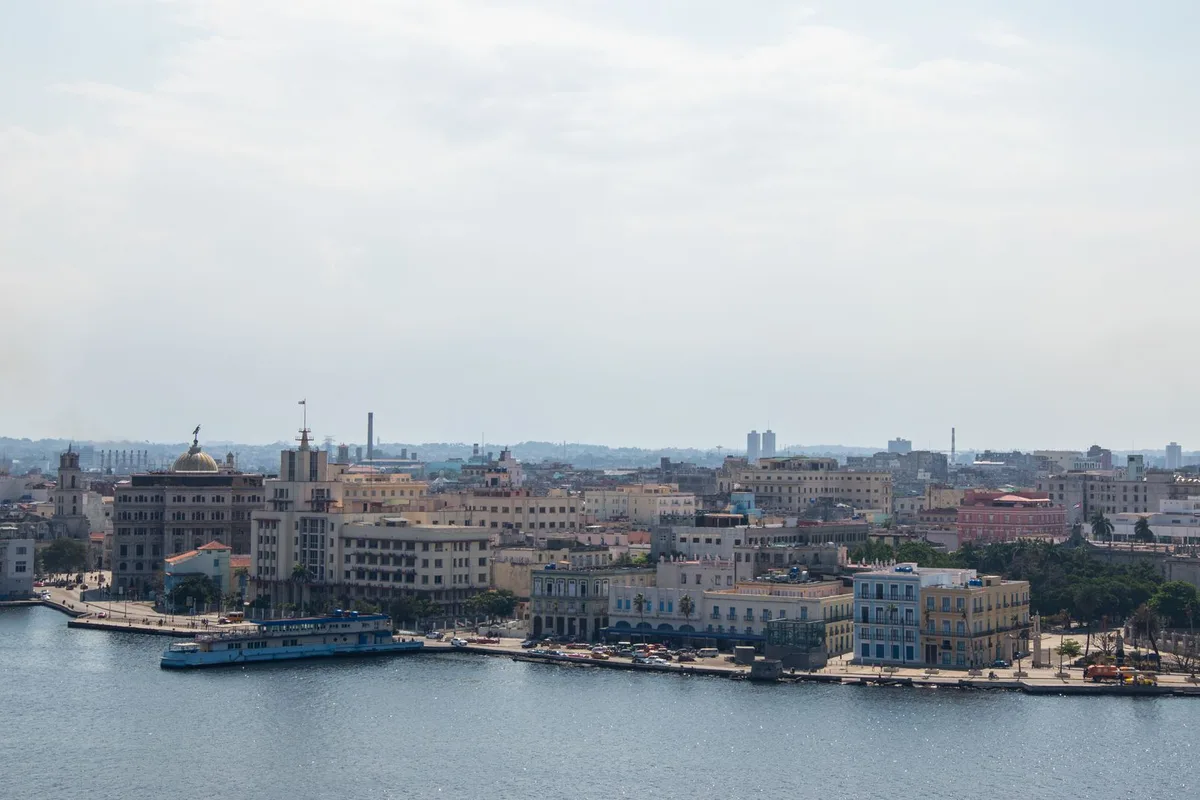
Three gateways feed Trinidad, and the honest choice is distance: Santa Clara (SNU) is the closest airport with real flights, about 110 km north; Cienfuegos (CFG), about 85 km west, handles few charters; Havana (HAV) is the main gateway. The legs in:
Choose the coach with light bags and a booked seat; choose a car when coach times strand you — fuel shortages have thinned services, so confirm the day before. In town, walk the old centre, ride bicitaxis for short hops, and take a taxi or bus to Playa Ancón, fare agreed first. Skip the rental car.
In the city
Start at Plaza Mayor.
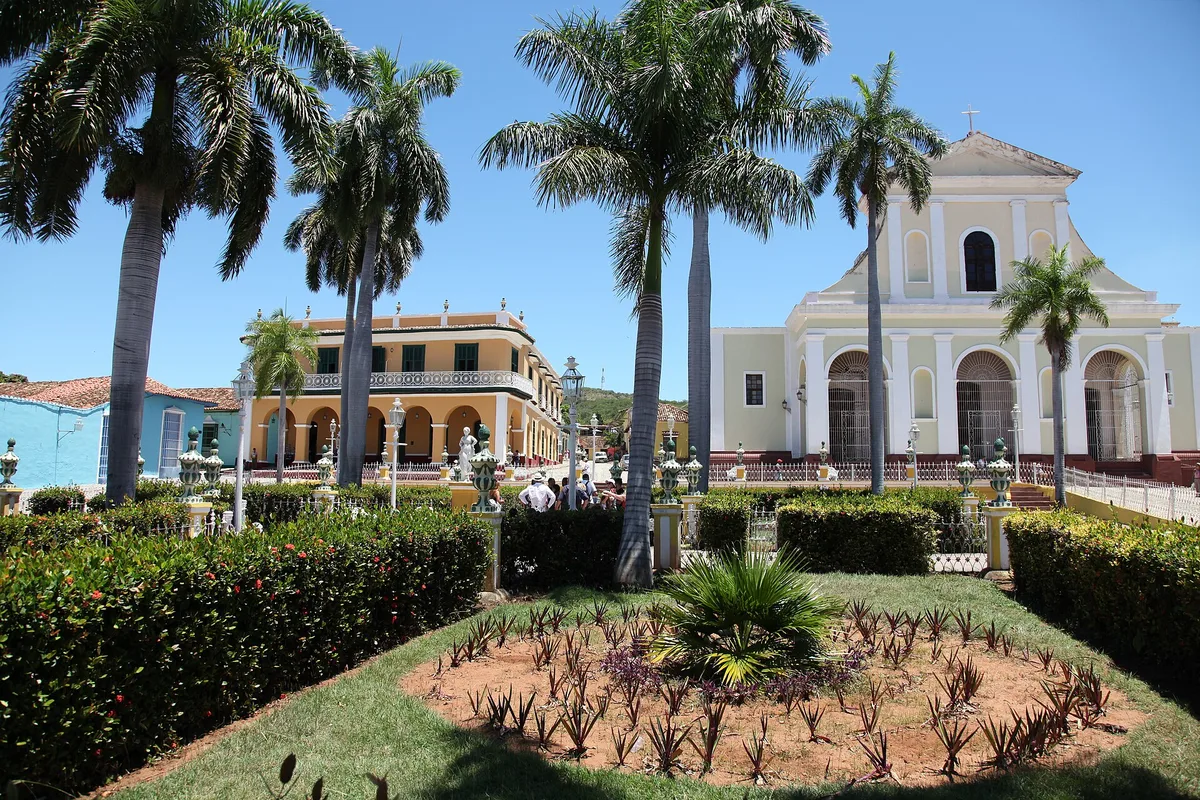
Walk the sloping square first, ringed by sugar-baron mansions: the Church of the Holy Trinity at the top, the Museo Romántico in the Palacio Brunet — 19th-century furniture in the house sugar built — and the archaeology museum opposite.
Climb a tower.
Take the bell tower of the old San Francisco convent, now the Museo Nacional de Lucha Contra Bandidos, for the view over red roofs to the Escambray, then the Palacio Cantero tower.
Drink the canchánchara.
Order Trinidad's own cocktail — rum, honey and lime in a clay cup — at the Taberna La Canchánchara on Calle Real del Jigüe, where the recipe is said to come from the independence wars.
End on the Casa de la Música steps.
Sit on the open-air staircase beside the church after dark, where son and salsa bands play and the town drifts past. By day, the workshops below the plaza sell the town's pottery.
Where to stay your first nights
Splurge
Lola Trinidad.
Best for the boutique splurge — a family-run colonial mansion of 10 rooms, patio breakfasts and a balcony over Calle Maceo
Stay at Calle Maceo 415, between Francisco Javier Zerquera and Colón — a family-owned boutique casa in a restored mansion, 10 rooms around a courtyard patio, and a balcony for the evening mojito.
Mid-range
Hostal Las Terrazas de Isabel y Eusebio.
Best for terrace views — two rooms sleeping four in a family home, terraces over the rooftops to the Escambray and the sea
Sleep at Calle Jesús Menéndez (Alameda) 106, between Colón and Ernesto Valdés Muñoz — two rooms sleeping four, in the home of hosts with over twenty years in the trade, named for its terraces: views to the Escambray.
Budget
Hostal Guayabero.
Best for blackout-proof budget rooms — two rooms in a family casa with its own solar power, five minutes from Plaza Mayor
Bed down in a family casa in the centre, five minutes from Plaza Mayor — two rooms, a terrace, breakfast for about US$5, and the detail that matters in 2026: its own solar system, so fans survive blackouts.
Sleep in the historic centre — Plaza Mayor, the paladares and the music steps sit inside a ten-minute walk, and the Viazul terminal is at the old town's edge. Casas particulares — licensed private rooms in family houses — are the default: better value than state hotels, hosts who fix drivers and money-changing, and the money goes to a household.
Travelling from the US? All three are privately run casas, the standard stay under support-for-the-Cuban-people trips. Federal rules bar stays at Prohibited Accommodations List properties, so check the current list before booking a state hotel.
Where to eat first
Eat the canon first: ropa vieja, shredded beef in a pepper-tomato sauce; congrí, black beans and rice cooked together; lechón, slow roast pork; and the south coast's lobster when the boats have been out. The paladar — a private restaurant in a family mansion — is where Trinidad cooks best. Three first stops:
Sol Ananda, Calle Desengaño, facing Plaza Mayor.
Start in one of the oldest houses in town — Cuban and seafood plates, live music, and the plaza at the door. Book ahead in season.
Restaurante San José, Calle Gutiérrez 328.
Eat big at the town's generous all-rounder — Cuban classics, fish, pizza and pasta in portions built for sharing, a rooftop bar above.
Taberna La Canchánchara, Calle Real del Jigüe 90.
Finish where the town's drink was born: the canchánchara in its clay cup, a house band, and a courtyard that fills by afternoon.
Day trips and more
Three escapes cover Trinidad's other faces: the beach, the sugar valley and the waterfalls. All three are arranged on the ground, through a driver your host trusts. Book Viazul coaches online before you land for the onward legs below.
Playa Ancón
Ride down the peninsula to 4 km of white sand and calm water, a reef offshore for snorkelling and boat trips sold on the beach. A taxi runs about 20 minutes, agreed first; go on a weekday. There is no online booking — the taxi is arranged on the day, or through your host.
Valle de los Ingenios
Drive about 12 km east into the UNESCO-listed sugar valley: the Manaca Iznaga estate and its 45-metre tower, climbed for the view over the cane fields, and the San Isidro ruins. A car and driver is arranged through your host; never count on the tourist train.
Topes de Collantes
Climb about 20 km into the mountains, to a reserve at around 800 metres where trails run through pine and fern forest to the Salto del Caburní, a 62-metre fall into a swimming pool. Go with a driver and guide from your host, and carry swim kit — the climb back is steep.
Two onward day trips run on the coach network. Cienfuegos, the bay city about 85 km west — a French-founded grid, the Palacio de Valle over the bay and a malecón for the evening: Viazul runs the leg in about 1.5 hours, twice a day. Check availability →
Santa Clara, about 110 km north
2.5 hTrain
— Che Guevara's mausoleum and the armoured train his forces derailed in 1958. Viazul and colectivos cover the leg in about 2 to 2.5 hours. Check availability →
When to go and what it costs
Come November to April — warm days, cooler nights — and book casas and paladares ahead: December to March is when Trinidad fills. Come May or October for the shoulder version: cheaper rooms, greener country, real rain and the edges of hurricane season (June to November, peaking August to October).
Budget by the fixed costs: eVisa about US$50, a casa room US$20 to 35 a night, breakfasts US$4 to 6, paladar mains to about US$20, the Havana coach US$25. The variable is the rate: official and informal rates sit in the hundreds of pesos per dollar and move weekly — in late October 2026 the informal dollar passed 800 pesos. Check elTOQUE the week you fly.
What to pack
Tap items to check them off — your list is saved on this device.
Pack for heat, cobbles and a cash economy. This is the full list:
Add the Cuba layer: your whole budget in cash (small, clean bills), every medicine you rely on — pharmacies run short — and toiletries for the trip. Add a torch, printed eVisa and D'Viajeros copies, and shoes with grip: the cobbles are treacherous, worse when wet.
Language, visa and entry
Spanish runs Trinidad: casa hosts and paladar staff often work in English, but taxis and markets run on Spanish — a greeting before a question is local etiquette. Six phrases do most of the work:
HolahelloGraciasthank youPor favorplease¿Cuánto cuesta?how much does it cost?La cuenta, por favorthe bill, please¿Dónde está la calle…?where is … street?
The paper tourist card is gone: since July 2025 visitors enter on an eVisa from evisacuba.cu — about US$50, single entry, 90 days, extendable once. Apply at least 72 hours before you fly. Every traveller also completes the free D'Viajeros form (dviajeros.mitrans.gob.cu) within seven days before arrival — its QR code is checked at the airline desk and scanned on landing. You need a passport valid for your stay — many airlines ask six months — an onward ticket, and proof of medical insurance valid in Cuba; US fares fold an insurance charge into the ticket. Leave the drone at home: confiscated without a permit. Declare cash over US$5,000. Casas are licensed rentals — your host registers your passport on arrival.
Tourism is not an authorised category for US visitors: Americans travel under one of OFAC's twelve general licence categories, usually support for the Cuban people — a full-time schedule built on the private sector casas, paladares, drivers, no dealings, direct or — since 30 September 2026 — indirect, with Restricted List entities, no Prohibited Accommodations List stays, records kept five years.
Safety and health
Change money only through people you trust
The street rate is real, but street changers earn from short-counts and counterfeit notes. Your casa host changes money at the going rate or says honestly who does — checking elTOQUE's daily figure first is the whole defence.
Agree every fare before the car moves
No taxi a visitor takes runs on a meter that matters. Whole car, one price, currency named. Around the terminal and Plaza Mayor, expect jineteros — hustlers steering you to a cousin's casa, bar or cigar deal, all on commission. A polite no ends it.
Plan around the blackouts
Rolling power cuts are a daily fact of Trinidad life in 2026. Casas with solar panels or generators are worth asking for; keep the power bank charged, the torch handy, water in reserve.
Drink bottled water, and take mosquitoes seriously
Tap water is not for drinking in Trinidad. Dengue and other mosquito-borne viruses circulate year-round and surge in the wet months — repellent in the day bag, sleeves at dusk. Care is paid in hard currency — why the insurance proof matters. Police 106, ambulance 104, fire 105.
The road in, the paperwork and the cash, in short.
Facts checked October 2026.
There is no airport in Trinidad itself. Fly to Santa Clara (SNU, about 110 km), Cienfuegos (CFG, about 85 km) or Havana (HAV), then ride the road leg: the Viazul coach from Havana takes about 6 hours for about US$25; from Santa Clara a coach, colectivo or taxi takes 2 to 2.5 hours.
No. Since 1 July 2025 visitors enter on an electronic visa from evisacuba.cu — about US$50, single entry, valid 90 days and extendable once. You also complete the free D'Viajeros form online within seven days before arrival and show its QR code at check-in and on landing.
No — plan on cash only. US-issued cards never work in Cuba, and Visa and Mastercard processing was suspended island-wide in June 2026, so no card is a backup. Bring your full budget in clean dollar or euro notes and change money through your host.
Your whole budget, in cash — there is no card fallback. Mid-range days (a casa room at US$20 to 35, paladar meals, taxis, a day trip or two) run roughly US$50 to 90. Change money in tranches through your host, and check elTOQUE's daily rate before anyone quotes you.
Yes, under an OFAC general licence — pure tourism is not authorised. The usual category is support for the Cuban people (31 CFR 515.574): a full-time schedule built on private casas, paladares and drivers, no direct or indirect dealings with Cuba Restricted List entities, no Prohibited Accommodations List stays, and records kept for five years.
November to April: dry, warm days and the old town at its best. Hurricane season runs June to November, peaking August to October; May and October are the shoulder compromise — cheaper rooms, real rain.
Prices are typical October 2026 rates in US dollars (USD); peso equivalents move with the exchange rate week to week, so the guide prints the mechanism, not a single rate.
Trinidad, Cuba, Saved for After You Land
Landing soon? Get the printable PDF — the essentials from this guide, formatted for your phone:
The airport transport cheat sheet, with ticket links
Our 3 restaurant picks, with maps
The packing checklist
One email with your Trinidad, Cuba PDF (guide version: Oct 2026). Fare changes and new guides after that. No spam, unsubscribe anytime.
Sources and last verified
Entry against the official portals (evisacuba.cu, since 1 July 2025; dviajeros.mitrans.gob.cu). US rules against OFAC's regulations and the September 2026 amendments (31 CFR 515.574; indirect Restricted List transactions banned from 30 September 2026). Money conflict, printed deliberately: Banco Central's floating rate stood near 720 to 738 pesos per dollar in late October 2026 while the informal rate (elTOQUE, CiberCuba) passed 800 — 828 to 834 on 23 and 24 October — so the guide prints the mechanism, not a rate. Cards: US-issued cards never worked; Visa and Mastercard processing was suspended on 6 June 2026. Hotels against their own listings; Expedia rate-limited this build, so no page could be opened and verified and all three carry no booking link. Premise correction: Iberostar ended all Cuba operations on 24 July 2026 and Blue Diamond handed its Mystique and Royalton properties, Trinidad's included, back to Gaviota on 30 May 2026 — branded state hotels are not printed as bookable picks; the three stays are private casas verified active in October 2026 listings. GetYourGuide does not operate in Cuba (its Trinidad page resolves to unrelated Lithuania tours); day-trip buttons point to Viazul. Last verified October 2026.
Affiliate disclosure: hotel names, transfers, experiences, and products linked in this guide may earn After You Land a commission at no extra cost to you. Prices and times were checked in Oct 2026 and change often — confirm before you book.