Krakow: your first hour after landing
You have just landed in Kraków — the Polish capital that survived the war, so the square you are about to walk into is the real medieval thing: the largest in Europe, with a bugle call breaking off mid-note every hour from St Mary’s tower. This guide covers the 17-minute airport train, Wawel and Kazimierz, the salt cathedral at Wieliczka and the journey to Auschwitz-Birkenau, plus żurek, milk bars and the Tatras.
In this guide
You just landed in Kraków. The airport train reaches Kraków Główny in 17 minutes for 20 zł, and the square at the end of the line is the largest medieval square in Europe — the real thing, not a rebuild. Sort your Airalo eSIM before you land, and book Wieliczka and Auschwitz ahead — the salt mine runs on timed tours, and the memorial sells no tickets on site at all.
Quick facts
Airport
Getting in
Currency
Languages
Time zone
Emergency
Plugs
Tap water
Tourist tax
Best months
Map
Stays, sights, and landmarks in Krakow — live hotel prices plus the key places from this guide.
Settle in
Ride the airport train
A covered walkway from the terminal, about 17 minutes to Kraków Główny, then a 10-minute walk to the Main Square.
Buy the right first ticket
The airport train takes its own 20 zł rail ticket — city tickets do not cover it. A 60-minute city ticket at 8 zł is valid in every zone and covers bus 300 plus your onward tram.
Validate the moment you board
Stamp paper tickets and activate app tickets before the vehicle moves — inspectors work the airport routes.
Walk the Planty ring once
One circuit passes the Barbican, the university quarter, the Franciscan church and the foot of Wawel.
Be on the square on the hour
The hejnał, from St Mary's taller tower, sounds every hour and breaks off mid-phrase.
Eat something properly Polish first
An obwarzanek — the braided bread ring from blue street carts — costs a few złoty; the beer hall at the foot of Wawel below feeds generously.
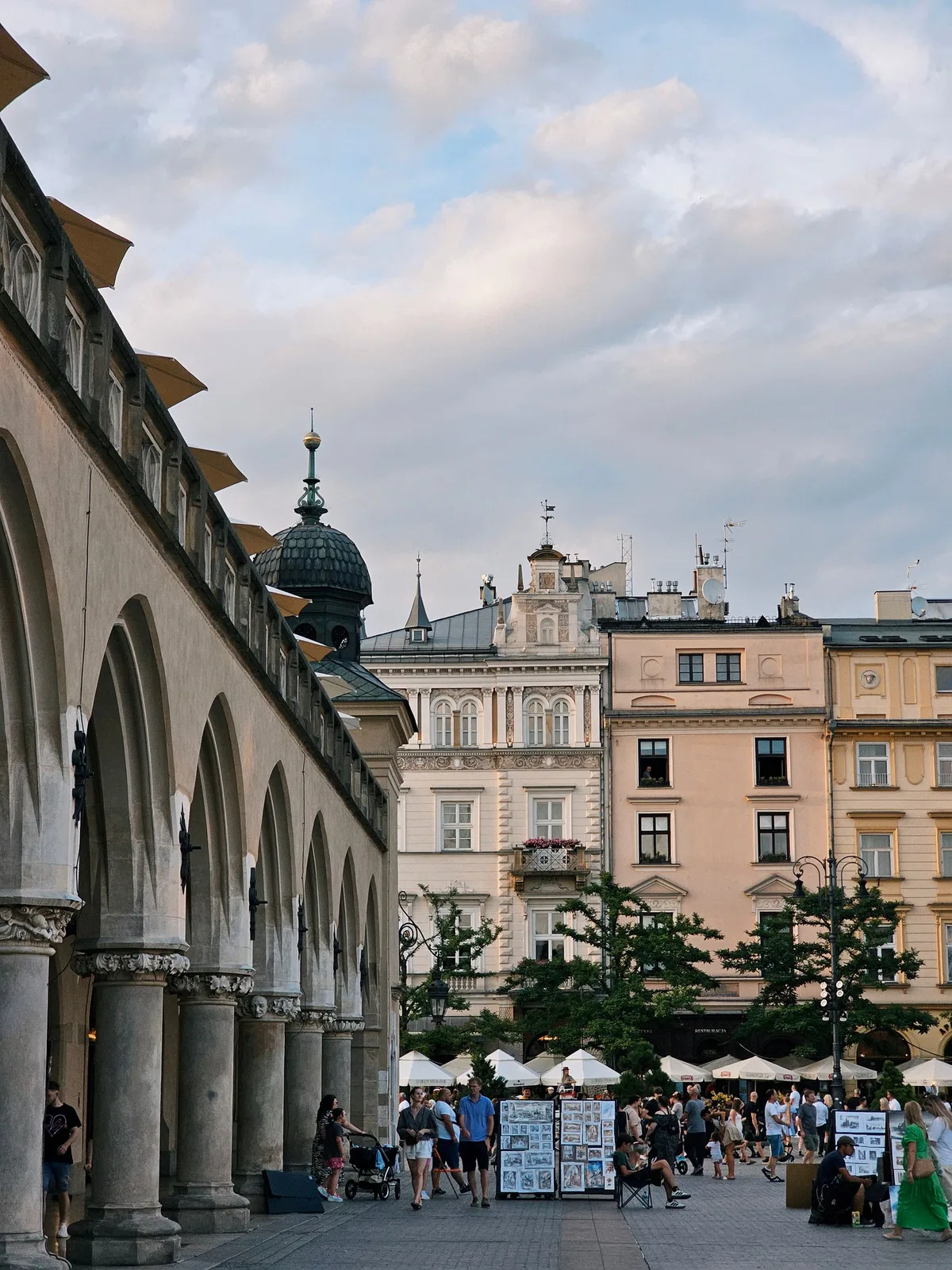
Kraków's centre is a walking city wrapped in a park: the Planty — gardens where the medieval walls stood — ring the Old Town, Wawel Hill at the southern end above the Vistula, Kraków Główny station just beyond the ring's north-east corner and Kazimierz a flat 15-minute walk south of Wawel. Inside the ring, traffic is residents-only.
Getting around

Times are airport to city centre.
Airport train (SKA1)
Koleje Małopolskie from Kraków Lotnisko, a covered walkway from the terminal; half-hourly through the day to Kraków Główny
Bus 300
The fast airport bus to the main station area; ordinary 60-minute city ticket, valid in all zones
Official airport taxi
From the rank outside arrivals; fixed fares by distance zone, never a running meter
Bolt or Uber
Usually the cheapest car door to door; price agreed in the app before you ride
Trams are Kraków's backbone: a dense web radiating from the Old Town ring, buses filling the suburbs. Inside the Planty the city is effectively pedestrian — trams drop you at the ring and your feet take over. After midnight, night buses take over.
Fares were revised in March 2026, so older guides quote cheaper tickets. Timed tickets are valid in every zone, airport included: 15 minutes 4 zł, 30-minute or single-trip 6 zł, 60 minutes 8 zł, 90 minutes 9 zł. A 24-hour ticket costs 20 zł for the city zone, 25 zł covering the airport and suburbs. Buy at stop machines, tap a contactless card aboard most buses and trams, or use the mKRK and Jakdojade apps.
Lines 208 and 252 also serve the airport but wind in slowly — take the 300; the night line 902 runs back to the airport in the small hours. Or skip thinking: Welcome Pickups puts a driver in arrivals with a name board at a price fixed when you book.
In the city
The sights stack into two clusters — the Main Square and Wawel at the centre, Kazimierz and Podgórze to the south — with the Rynek Underground beneath your feet.
- The Main Market Square and the Cloth Hall — The Rynek Główny, laid out in 1257, 200 metres a side, is among Europe's largest medieval squares: flower stalls, carriages and café terraces under St Mary's twin towers. The Cloth Hall sells amber and carved wood below, a gallery of 19th-century Polish painting upstairs.
- St Mary's Basilica — Sightseeing entry 20 zł through the visitors' door, Mon-Sat 11:30-18:00, from 14:00 Sundays; arrive for 11:50, when Veit Stoss's great carved altarpiece is opened. In season, climb the taller bugle tower for 20 zł.
- Wawel Castle — The State Rooms are the headline: 49 zł, timed — book online before the day. Main exhibitions close Mondays, when a rotating set of rooms opens free — free passes from the ticket office, gone by mid-morning. In season, book headline slots on GetYourGuide rather than trusting the queue.
- Wawel Cathedral — A separate building, ticket and queue from the castle: 26 zł covers nave, royal crypt tombs, the Sigismund Bell climb and the cathedral museum. The hill, courtyard and fire-breathing riverside dragon are free.
- The Rynek Underground — Four metres beneath the Cloth Hall, the excavated medieval market is a museum of early Kraków: 45 zł, free on Tuesdays, closed the second Monday of the month. In summer, reserve on Tiqets a few days ahead.
- Schindler's Factory — In Podgórze, the enamel factory's exhibition Kraków under Nazi Occupation 1939-1945 is one of the country's finest history museums. Since January 2026 entry is 60 zł, and the same ticket covers the Pharmacy Under the Eagle and Pomorska Street exhibitions within seven days. Tickets are timed and named — book ahead and bring ID. Mondays: 10:00-15:00, free permanent exhibition; closed the first Tuesday of the month.
- Kazimierz and the Old Synagogue — The old Jewish quarter: Szeroka street, the Remuh cemetery wall patched with tombstone fragments, synagogues turned museums and bookshops. The Old Synagogue, the oldest surviving in Poland, holds a museum of Jewish history and ritual. Return in the evening, when Plac Nowy fills with the city's best bars.
- Collegium Maius and the university quarter — The Jagiellonian University's oldest college, where Copernicus studied, opens its Gothic courtyard free; its clock plays a procession of figures at set hours.
The Vistula boulevards and the Planty make two cycle circuits, and paths south run traffic-free towards Tyniec abbey; for guided rides and rentals, BikesBooking lists the city's shops.
Compare the city pass on Klook against the free-day strategy first: Rynek Underground free Tuesdays, Schindler's Factory free Monday mornings, Wawel's free rooms Mondays — a planned week can make the pass unnecessary.
After you land in Krakow: Bookable experiences
Where to stay your first nights

Hotel Copernicus.
Best for Kanonicza luxuryA Renaissance palace on Kanonicza 16, in the shadow of Wawel: 29 rooms, frescoed ceilings, a pool in the Gothic cellars and a terrace facing the castle.

PURO Kraków Stare Miasto.
Best for Old Town designThe Polish design chain's house at Ogrodowa 10, beside Galeria Krakowska, a short walk from station and square: tablet check-in, calm Scandinavian-Polish interiors and a price-to-design ratio the nearby chains do not match.
Greg and Tom Hostel.
Best for Old Town on a budgetOne of the city's first hostels, at Pawia 12 by the station, a 10-minute walk from the square: dorms and private rooms, a free breakfast and a free communal dinner most nights. Guests must be 18 or over.
Stay inside or just beside the Planty ring on a first visit: the Old Town end for the sights, the streets near Kraków Główny for early trains and day trips, Kazimierz for lively evenings and quiet mornings. No city visitor tax — the price quoted is the price you pay.
Choose Kazimierz on a return visit, when the quarter itself is the point.
Where to eat first

Kraków eats Polish food proudly and cheaply: żurek, the sour rye soup with sausage and egg, is the bowl to order first, and the beer halls at the foot of Wawel serve portions measured in kilos.
Pod Wawelem Kompania Kuflowa — the beer hall by the castle.
Map → At Świętej Gertrudy 26, where the Planty meets the foot of Wawel, open daily 12:00-23:00. The pork knuckle is the house legend and feeds two; litre steins, long benches and a garden along the Planty.
Kuchnia Staropolska U Babci Maliny — old-Polish home cooking.
Map → At Szpitalna 38, a short walk from the square, open daily 11:00-23:00. Grandmother's cooking in a wood-panelled dining room: żurek in a bread bowl, pierogi, goulash and compote at prices that recall the milk bars.
Mleczarnia — the Kazimierz garden bar.
Map → At Beera Meiselsa 20 in Kazimierz, open daily from 10:00 to midnight or later. Part café, part beer garden: mismatched furniture, candles in jars and a leafy garden across the lane.
Day trips and more
Both defining day trips run on advance booking. Wieliczka is the easy half-day — reserve the English tour on Tiqets in season, when slots sell out. Auschwitz-Birkenau is a full day and a different kind of visit.

Wieliczka Salt Mine
Worked since the 13th century: chapels, lakes and statues of kings and saints carved from rock salt, 3 km of chambers, 800 steps down to 135 metres below the surface. English Tourist Route: 159 zł; Polish-language tour: 119 zł — the saving if your Polish stretches that far. Combined city-and-rail 70-minute ticket from Kraków Główny: 10 zł.
Check availability →
Auschwitz-Birkenau
The preserved site of the Nazi concentration and extermination camp at Oświęcim, where more than a million people, most of them Jews, were murdered 1940-1945. Admission is free, but every visitor needs a personalised entry pass booked in advance at visit.auschwitz.org — checked against photo ID; since March 2026 there are no sales at the gate. Individual visitors join a museum educator's tour — in English, about 3.5 hours, 150 zł. Unguided entry is offered only in the afternoon, still booked online. Not recommended for children under 14. Photography is permitted in most areas — never in the room where victims' hair is displayed, and no flash indoors. The museum sets a strict bag-size limit.
Check availability →
Zakopane and Morskie Oko
The wooden-villa resort town under the Tatra peaks: carved timber chalets, smoked oscypek at the market, Krupówki's cafés under Giewont. From the bus terminus at Palenica Białczańska, a 9 km lakeside road — walked or ridden in a horse cart — leads to Morskie Oko, the great green lake of every Tatra postcard. A very long day with the journey each way — better as an overnight.
Check availability →When to go and what it costs

The free days do most of the budgeting. The 60-minute ticket at 8 zł and the 24-hour pass at 20 zł keep transport trivial; museums run from St Mary's 20 zł to Schindler's Factory at 60 zł, Stack the free days — Schindler's Factory and Wawel's free rooms on a Monday, the Rynek Underground on a Tuesday. A full milk-bar lunch of soup, a main and kompot lands around 20-25 zł; a half-litre of lager in a central bar runs about 15-20 zł, Kazimierz's cellar bars cheaper than the square's terraces.
If a delayed or cancelled flight wrecks the plan, keep the paperwork: for EU261-covered disruption, AirHelp handles the compensation claim on a no-win, no-fee basis.
What to pack
Tap items to check them off — your list is saved on this device.

Kraków's constants are cobbles, distance and one layer of weather insurance — and the salt mine holds a steady 17 °C all year, whatever the surface is doing, so you will want the layer underground too.
- Comfortable walking shoes Shop walking shoes on Amazon →
- Sunscreen Shop sunscreen on Amazon →
- Reusable water bottle Shop water bottle on Amazon →
- Phone charger and power bank Shop power bank on Amazon →
- Daypack Shop daypack on Amazon →
- Sunglasses Shop sunglasses on Amazon →
- Light rain jacket Shop rain jacket on Amazon →
As an Amazon Associate I earn from qualifying purchases.
Language, visa and entry
✓ Visa-free entry

Polish is a West Slavic language in the Latin alphabet with a few extra letters, and its spelling is far more regular than English — learn the sounds and you can read a sign aloud and be understood. Dzień dobry is the safe all-day greeting, and younger Krakovians will answer in easy English.
Poland belongs to the EU and to Schengen, so your Schengen allowance covers the days here. US, Canadian, Australian and British passport holders enter visa-free for up to 90 days in any 180-day period. The EU Entry and Exit System now records fingerprints and a facial image at the border in place of a passport stamp; ETIAS pre-travel authorisation is not yet in operation. Check the entry rules on gov.pl before you fly.
Safety and health
Kraków is a calm, heavily visited city; its risks are the practical kind, not the personal kind.
Mind the winter air
On still, cold days Kraków's air can be poor: the city banned solid-fuel stoves in 2019 and replaced thousands of furnaces, but smoke drifts in from surrounding villages. Check the air-quality index on winter mornings; if sensitive, wear a mask on the worst days.
Validate every ticket
Plain-clothes inspectors work the trams, buses and airport routes; riding without a validated ticket costs a 266 zł on-the-spot fine. Stamp paper tickets as you board and activate app tickets before the vehicle moves.
Watch pockets at the hub
Pickpockets work the Main Square at its busiest, the packed trams and the station underpass at Kraków Główny. Keep the phone in a zipped pocket; agree taxi prices in an app or at the official rank, never with a driver touting in arrivals.
Respect trams and ice
Trams have absolute priority, run quietly on steel and brake for nobody — look both ways even on a green man. From December to February the cobbles ice over; walk the Old Town in shoes with grip and give yourself time.
The Old Town's stag-party strip runs late and loud: watch your drink, settle the price of anything before it starts, and treat a stranger's club invitation as the start of an expensive evening.
For anything medical, dial 112. A European Health Insurance Card or UK GHIC covers state treatment; travel insurance should cover the rest. Apteka pharmacies are everywhere, and pharmacists advise over the counter.
Related destinations
If you liked Krakow, try these next:




Frequently asked questions
The facts that matter after you land in Kraków.
Verified against MPK Kraków, the airport railway, Wawel, Schindler's Factory and the Auschwitz-Birkenau Museum, October 2026.
The SKA1 train leaves the station beside the terminal every half hour through the day and reaches Kraków Główny in 17 minutes for 20 zł.
Bus 300 is the budget alternative at about 40 minutes on an ordinary city ticket; the official airport taxis charge fixed zone fares of 89, 109 or 129 zł by distance.
MPK revised its fares in March 2026: a 15-minute ticket is 4 zł, 30 minutes 6 zł, 60 minutes 8 zł, and a 24-hour pass is 20 zł in the city zone.
Timed tickets are valid in all zones, so the same 8 zł 60-minute ticket covers the airport bus 300. Buy in the Jakdojade app or tap a card on board.
No — Monday is its free day, with the permanent exhibition open 10:00 to 15:00 on limited tickets collected on site. It closes instead on the first Tuesday of each month.
Since January 2026 the standard ticket costs 60 zł and also covers the Pharmacy Under the Eagle and the Pomorska Street branch for seven days. Tickets are timed and named — book ahead.
No. Since March 2026 the memorial sells nothing on site — every entry pass, including the free unguided afternoon slots, is booked online at visit.auschwitz.org.
Most visitors join a guided educator tour: the English general tour costs 150 zł and runs about three and a half hours. Passes are personalised and checked against ID.
The English-language Tourist Route costs 159 zł; the Polish-language tour is 119 zł. The route covers about 3 km of chambers, down to 135 metres, over roughly 800 steps.
The train from Kraków Główny to Wieliczka Rynek-Kopalnia takes about 25 minutes, and a combined city-and-rail 70-minute ticket at 10 zł covers it.
The Castle State Rooms are 49 zł with timed entry; the Cathedral runs on a separate combined ticket at 26 zł covering the nave, the royal crypts, the Sigismund Bell and the museum.
The State Rooms close on Mondays, when selected exhibitions open free instead. St Mary's Basilica in the square charges 20 zł for sightseeing visits.
One airport only — no second-airport trap; MPK fares were revised in March 2026; tap water safe; Type C and E sockets at 230V; emergency 112.
Krakow, in your pocket
Landing soon? Get the printable PDF — ticket links, the airport transport cheat sheet, our 3 restaurant picks with maps, and the packing checklist. Everything above, formatted for your phone.
One email with your Krakow PDF. Fare changes and new guides after that. No spam, unsubscribe anytime.
Sources and last verified
Kraków facts checked October 2026 against MPK Kraków for fares and tickets, including the tariff revised in March 2026; Koleje Małopolskie for the airport train; Kraków Airport for the official taxi zone fares; Wawel Royal Castle and the Wawel Cathedral chapter for prices, closing days and free admission; the Museum of Kraków for the Rynek Underground and Schindler's Factory, including its January 2026 prices; the St Mary's Basilica parish for sightseeing hours and tickets; the Wieliczka Salt Mine for Tourist Route tour prices; the Auschwitz-Birkenau State Museum for entry-pass rules and the educator tour price list in force from February 2026; the City of Kraków and the October 2026 local-fee legislation for the visitor-tax position; and gov.pl and the European Commission for entry rules, the Entry and Exit System and ETIAS.
Affiliate disclosure: hotel names, transfers, experiences, and products linked in this guide may earn After You Land a commission at no extra cost to you. Prices and times were checked in Oct 2026 and change often — confirm before you book.