Ushuaia: your first hour after landing
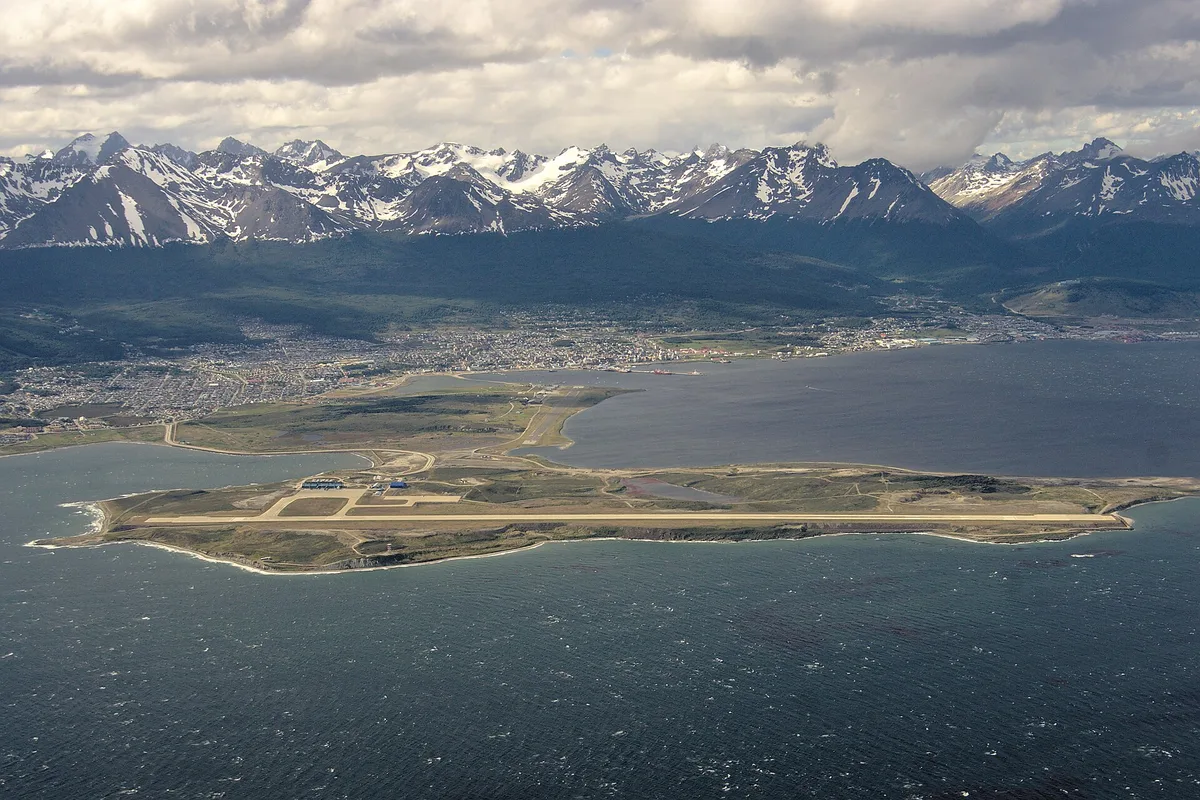
You have just landed at Malvinas Argentinas, on a peninsula about 6 km from the grid — the airport of Argentina's southernmost city, where almost every flight connects through Buenos Aires. There is no airport bus: a taxi, a remis or a hotel shuttle crosses the causeway to Avenida San Martín. This guide covers the ride in, where to sleep, the VAT exemption and city visitor fee, the first centolla dinner, and the channel, park and lagoon days.
In this guide
You just landed in Ushuaia. The airport sits on a peninsula about 6 km out and there is no airport bus — a taxi, a remis or a shuttle crosses the causeway, with an Airalo eSIM live for maps and bookings, the 21% hotel VAT gone when you pay by foreign card, the park's ARS 40,000 entry budgeted into every park day, and the channel and train days that sell out first worth booking ahead through GetYourGuide.
Quick facts
Airport
Getting in
Currency
Languages
Time zone
Emergency
Plugs
Tap water
Tourist tax
Best months
Map
Stays, sights, and landmarks in Ushuaia — live hotel prices plus the key places from this guide.
Settle in
Touch down at USH and treat the first hour as admin: the airport sits on a peninsula about 6 km from the grid, there is no airport bus, and the first decision — taxi, remis or shuttle — is made at the kerb.
Set up data before you leave home — an Airalo eSIM loads in minutes, so maps work from arrivals. For a longer trip, compare Saily and Yesim.
The first-hour checklist:
- Take a metered taxi from the rank, a remis at a fare agreed before you ride, or your hotel's shuttle — never a tout's offer in the hall
- Keep your passport handy at check-in: foreign-card payment unlocks the 21% VAT exemption on the room
- Download park, train and channel bookings before you need them — the weather rearranges plans, and departures sell out
If a delayed flight wrecked the arrival, AirHelp checks the airline's compensation.
Getting around

Times are airport to city centre.
Taxi
Metered under the municipal tariff, with a 20% surcharge from 22:00 to 05:00 and on holidays; the rank sits outside arrivals — let the meter run and ignore touts in the hall
Remis (fixed-rate car)
The local pre-booked car: book at the airport desk or by phone and agree the fixed fare before you ride. Ride-hailing apps do not operate in Ushuaia — no Uber here
Shared or hotel shuttle
Shared transfers list from about US$10 a person, and many hotels run their own shuttle — Arakur charges US$30 a vehicle. Per-person pricing suits solo travellers; a taxi is cheaper for a group
Rental car
Desks in arrivals; a car earns its keep for the national park, the lakes road and Cerro Castor, not the centre. In winter Ruta 3 requires snow tyres or chains — ask the desk what is fitted

Ushuaia is a compact, steep grid along the Beagle Channel: the centre walks in minutes; everything beyond is a taxi, remis or tour-bus ride. There is no airport bus and no ride-hailing: Uber does not operate here. The rides in from USH:
Take a taxi for the simplest arrival; a remis or shuttle for a fare fixed before you land. Nights and holidays add 20% to the meter.
Prefer to be met? A Kiwitaxi transfer or Welcome Pickups puts a name board in arrivals. Driving yourself, price the pickup on AutoEurope first.
In town, walk the San Martín and Maipú spine. City buses (UISE, Mi Bondi app) run on SUBE at ARS 1,550 since September 2026, but none serves the airport — taxis cover the glacier and port, tour buses the park.
In the city
Stroll Avenida San Martín and the waterfront.
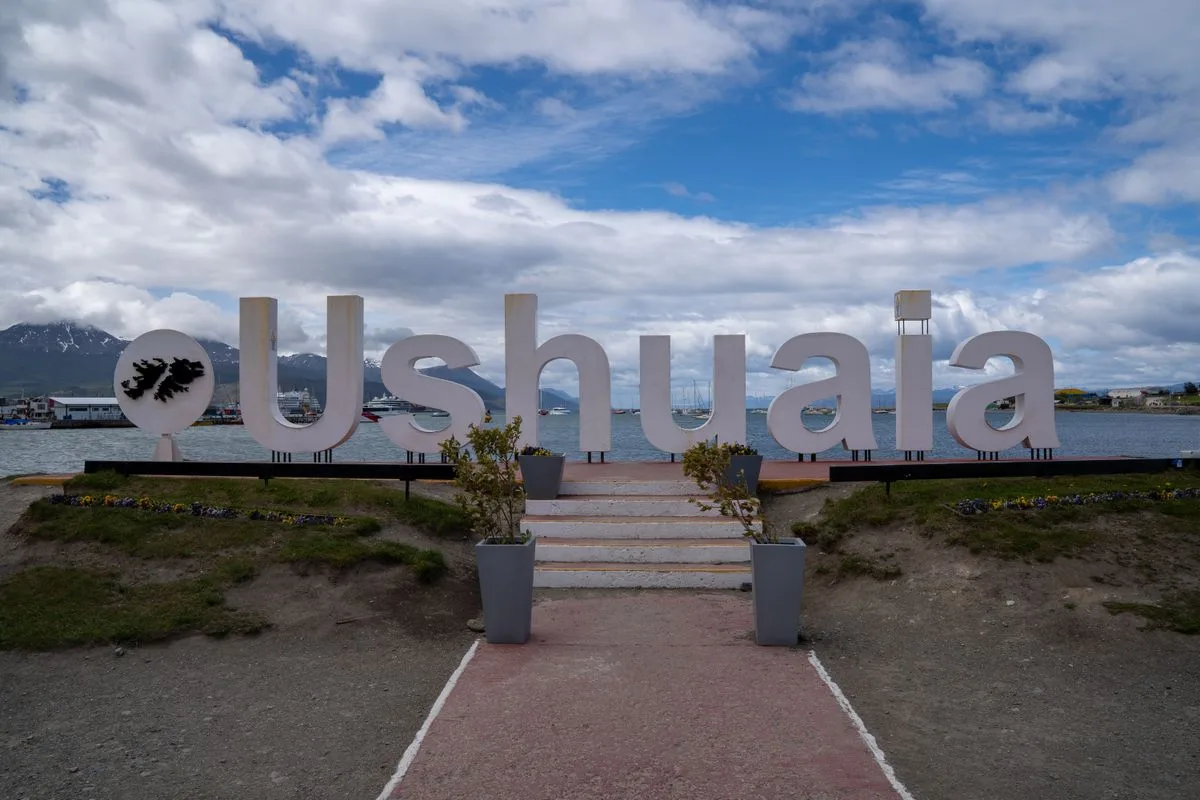
Walk the main street end to end — gear shops, bookshops, cafés under the Martial range — then drop to the port, where the big Ushuaia sign faces the channel and expedition ships load for Antarctica.
Tour the Museo Marítimo and the old Presidio.
Enter the former prison at Yaganes and Gobernador Paz, the panopticon that built this town: cell wings, a maritime museum, an Antarctic wing. Tickets are sold only at the door and stay valid two days — go early.
Climb to the Martial Glacier viewpoint.
Ride a taxi 7 km up to the trailhead and walk the old ski slope — the chairlift no longer runs, the trails are free. Go on a clear morning: modest ice, but the lookout over city and channel is the best free view in town.
Watch the Antarctic season from the pier.
Read the departure boards at the tourist port between October and March, when expedition ships cycle through almost daily. Last-minute berths surface at agencies on San Martín late in the season — luck, never a plan; verify the operator first.
Browse GetYourGuide for channel sailings and park days; compare Klook when stacking activities.
After you land in Ushuaia: Bookable experiences
Where to stay your first nights

Arakur Ushuaia Resort & Spa.
Best for the hillside splurge — pools, spa and nature reserve above the baySleep above the bay at Cerro Alarkén 1, inside the Cerro Alarkén nature reserve — 129 rooms, heated indoor and outdoor pools, a full spa, the La Cravia restaurant and a free centre shuttle. Book it for the fullest version of Fuegian polish.
Albatros Hotel.
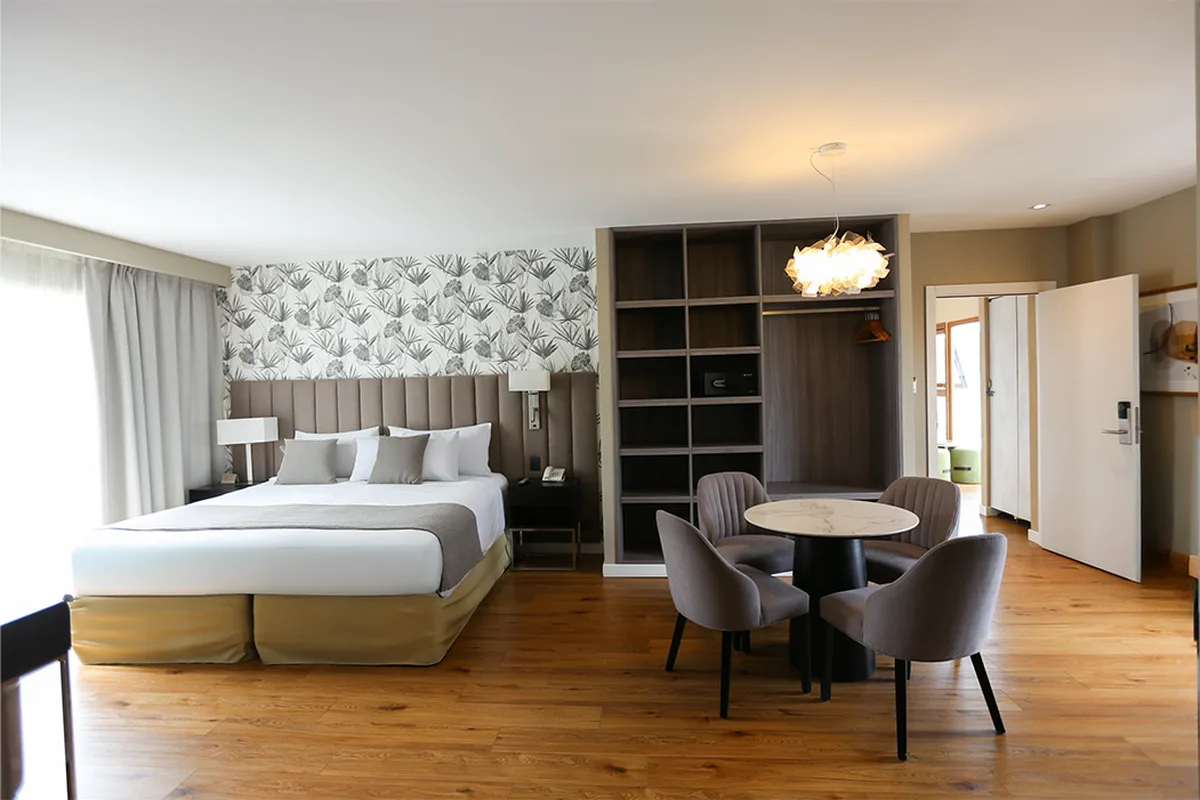
Best for a full-service base facing the portStay at Avenida Maipú 505, facing the port — a long-running four-star with buffet breakfast, a health club and spa, a ski room and the tourist pier minutes on foot. Book it for a full-service base mid-grid.

Antarctica Hostel.
Best for social budget beds — dorms and privates, big common roomBed down at Antártida Argentina 270, a few streets from the centre — dorms and privates with radiant heating, a big common room, breakfast and a shared kitchen, run for the trekking crowd. Book it for the social version of budget Ushuaia.
Base in the centre on a first visit — the streets between San Martín and the port put restaurants, tour desks and the pier at your door. Hillside resorts trade the walk for pools and views, with shuttles down.
Book ahead for December to February and the July ski weeks. Pay by foreign card, passport at check-in, to keep the 21% VAT off the room, and scan the bill for the visitor fee.
Where to eat first

Eat the channel. Ushuaia's table is built on centolla — king crab from the Beagle — backed by merluza negra (Patagonian toothfish), Fuegian lamb and the morning's catch. Three first stops, all within a few streets:
Kaupé, General Roca 470.
Book the city's fine-dining room — the Vivian family's seafood kitchen above the bay: centolla, black hake and scallops at dinner only. Reserve days ahead in season.
Volver, Avenida Maipú 37.
Eat inside the antique-crammed wooden house by the port — fishing nets and newspapered walls around plates of centolla and local fish. The classic Ushuaia dinner; arrive early or book.
El Viejo Marino, Avenida Maipú 227.
Share a whole centolla at the family seafood house a few doors along — generous, and priced below the famous names. Order the black hake if it is on; expect a queue at peak hour.
For crab-route days and seafood tours, browse the Ushuaia listings on GetYourGuide.
Day trips and more
Three anchors at three speeds: the channel by boat, the park by train and road, the valley on foot. Book the boat and train first.

Beagle Channel navigation
Three hours from the tourist pier: Sea Lion Island, Bird Island, then Les Eclaireurs, the lighthouse lit in 1920 on its rocky islet — not Jules Verne's lighthouse, whatever the brochures say. From about US$110. Check availability →

Tierra del Fuego National Park and the End of the World Train
Five hours with pickup: ride the old prison line into the park, then Lapataia Bay, where Route 3 and the Pan-American Highway end, Lake Roca and the Alakush centre. Rated 4.5 from 1,179 reviews, from about US$50. Check availability →

Laguna Esmeralda trek
Six hours, small group, pickup and box lunch included: about 10 km through lenga forest and peat bogs to the emerald lagoon under the Ojo del Albino glacier. Waterproof boots essential — the trail is wet year-round. Rated 4.9 from 352 reviews, from about US$99. Check availability →
Leave a spare day for Cerro Castor in winter, the crab sheds of Puerto Almanza, or the lakes road.
When to go and what it costs

December to February is peak summer: the longest days, Martillo Island's penguins in residence (about mid-October to the end of March), every trail open — and the strongest winds. Winter flips the town: Cerro Castor, the world's southernmost ski field, ran 26 June to 4 October in 2026, and July holidays fill the hotels again. March and November are the shoulders.
Budget in dollars; the peso follows at about ARS 1,530 to US$1 (October 2026). A city bus is about US$1; park entry ARS 40,000 (about US$26) for foreign visitors; the train's Turista fare ARS 80,000 (about US$52) from October 2026; a centolla dinner US$35 to 60 a person.
A backpacker in a dorm, cooking some meals, one big excursion: US$50 to 70 a day. Mid-range — a four-star room, seafood dinners, the park and the channel: US$150 to 220 a day. A splurge day with the hillside resort and a private guide passes US$400.
What to pack
Tap items to check them off — your list is saved on this device.
Pack for four seasons in a day — the wind can deliver all of them before lunch. This is the full list:
- Comfortable walking shoes Shop walking shoes on Amazon →
- Sunscreen Shop sunscreen on Amazon →
- Reusable water bottle Shop water bottle on Amazon →
- Phone charger and power bank Shop power bank on Amazon →
- Daypack Shop daypack on Amazon →
- Sunglasses Shop sunglasses on Amazon →
- Light rain jacket Shop rain jacket on Amazon →
Add the Ushuaia extras: a genuinely waterproof shell and warm mid-layer, waterproof boots, a windproof hat and gloves even in January, and a Type C and I adapter. In winter, rent ski kit in town.
Language, visa and entry
✓ Visa-free entry
Spanish runs the town, softened by a port city's habit of visitors. This was Yámana water long before it was an Argentine grid — the name is usually read as "bay that looks toward the west". Hotel English is strong; a little Spanish unlocks the remis desk.
Four phrases do the work:
Sort entry paperwork before booking anything non-refundable. US, Canadian, British, EU, Australian and New Zealand nationals (among 120-plus nationalities) enter visa-free for up to 90 days, extendable once. The old reciprocity fees are long scrapped.
Since 2025, under Decree 366/2025, foreign visitors must hold health insurance covering the whole stay, with a sworn declaration written into the entry rules. The declaration's regulation was still pending, so it may not be asked for at the desk — but the insurance provision is in force, and public hospitals require cover or prepayment.
Safety and health
Dress for wind that rewrites the plan
Fuegian weather turns in an hour: sailings cancel, park roads ice over, trailheads close. Build in a flex day, check the forecast the night before an excursion, and layer as if the afternoon will be colder — it usually is.
Walk the centre freely, and taxi the hills late
Ushuaia is one of Argentina's calmer cities; the grid stays busy late in season. The risks are petty: bags at pier-side café tables, pockets in tour-desk crowds. Use the hotel safe, and taxi up the steep streets after dark.
Pay by card, and keep the tax rules straight
Foreign-card payment with your passport unlocks the 21% VAT exemption — cash loses it. For pesos, use a bank or official exchange house, never a street changer; keep small notes for tips.
Respect cold water, high UV and the distance from help
The Beagle is near-freezing all year — swim nowhere outside a guided activity. Summer UV is fierce even through cloud. Insurance is an entry requirement here (see Language, visa and entry); emergencies are 911.
Related destinations
If you liked Ushuaia, try these next:
 The Americas
 The Americas
 The Americas
 The Americas
 The Americas
 The Americas
 The Americas
 The Americas
 The Americas
 The Americas
Frequently asked questions
The arrival, the end-of-the-world taxes and the two seasons, in short.
Fares against 2026 Ushuaia operator listings and fare reporting, October 2026; park fees against the national parks June 2026 schedule; entry rules against Decree 366/2025.
There is no airport bus. Take a metered taxi — about US$7 for the 6 km into town, 15 minutes — a remis at a fixed fare agreed before you ride (about US$10), or a shared or hotel shuttle at about US$10 a person. Ride-hailing does not operate here: no Uber.
No visa for most visitors: US, Canadian, British, EU, Australian and New Zealand nationals (among 120-plus nationalities) get up to 90 days visa-free, extendable once.
Yes — since 2025, Decree 366/2025 requires health insurance covering the whole stay, with a sworn declaration in the entry rules. The declaration's regulation was still pending in recent reporting, so it may not be requested at the desk, but the insurance provision is in force and public hospitals require cover or prepayment for non-emergency care.
Foreign visitors paying by foreign-issued card (or transfer from abroad) skip the 21% IVA on the room, and on breakfast inside the rate. Show your passport, ask for the class "T" invoice, never pay cash — cash loses the exemption. Ushuaia's approved Derecho de Uso Urbano adds 10 UVF (about US$10) for foreigners, via accommodation — check your bill.
December to February for hiking, the Martillo Island penguins and 17-hour days. For snow, Cerro Castor, the world's southernmost ski field, ran 26 June to 4 October in 2026. March and November are quieter and cheaper.
The park charges foreign visitors ARS 40,000 (about US$26) from 1 June 2026 — buy online, as gate-payment reports conflict. The train is separate: Turista ARS 80,000 (about US$52), October 2026 to March 2027; the park fee applies even if you only ride the train.
Peso fares change — the parks service, the train operator and your hotel bill always win.
Ushuaia, in your pocket
Landing soon? Get the printable PDF — ticket links, the airport transport cheat sheet, our 3 restaurant picks with maps, and the packing checklist. Everything above, formatted for your phone.
One email with your Ushuaia PDF. Fare changes and new guides after that. No spam, unsubscribe anytime.
Sources and last verified
Airport transfers triangulated from 2026 fare calculators and operator listings (taxi base US$1.50 plus about US$1 a km; shared transfers from US$10 a person) — no flat fare is published, and Uber does not operate in Ushuaia. City bus ARS 1,550 on SUBE from 8 September 2026 (UISE). Exchange anchor: about ARS 1,530 to US$1, October 2026. Park entry ARS 40,000 for foreign visitors from 1 June 2026; sources conflict on gate payment — pesos cash only versus card sales — so buy online in advance. Train Turista ARS 80,000, October 2026 to March 2027. Cerro Castor 2026: 26 June to 4 October. Hotel VAT per the foreign-visitor IVA rules (21% off room and in-rate breakfast; foreign card, passport, "T" invoice). Derecho de Uso Urbano: approved late 2024 at 10 UVF (about US$10) for foreigners over 12, via accommodation; opposition was immediate, no 2026 collection notice found — printed as approved and contested. Entry and insurance per Decree 366/2025, its declaration regulation still pending in recent reporting. GetYourGuide hub opened and heading-verified (ushuaia-l1851); the park-train and lagoon pages were opened and read; the Beagle navigation comes from the opened hub listing and the operator's partner listing, its product page not rendering here. Expedia: the Arakur page was opened and verified; Albatros and Antarctica Hostel URLs are empty pending the confirmation pass — the Albatros property page was not opened here, and no listing was found for the hostel. Photo credits as in the guide data. Last verified October 2026.
Affiliate disclosure: hotel names, transfers, experiences, and products linked in this guide may earn After You Land a commission at no extra cost to you. Prices and times were checked in Oct 2026 and change often — confirm before you book.