
San José, Costa Rica: your first hour after landing
You have just landed at Juan Santamaría in Alajuela, 17 km from a highland capital most travellers rush through — and miss. This guide covers the TUASA bus and taxi run in, where to sleep from the 1930 Gran Hotel to the original backpacker hostel, the onward-ticket rule, the first casado and gallo pinto, and the Poás, Arenal and Irazú days that fill day two.
In this guide
You just landed in San José. SJO airport sits 17 km away in Alajuela — the move is the TUASA bus at about CRC 730 or an orange taxi on the meter, with an Airalo eSIM live for maps, your onward ticket ready for immigration, and the volcano days that fill first worth booking ahead through GetYourGuide.
Quick facts
Airport
Getting in
Currency
Languages
Time zone
Emergency
Plugs
Tap water
Tourist tax
Best months
Map
Stays, sights, and landmarks in San José, Costa Rica — live hotel prices plus the key places from this guide.
Settle in
Touch down at SJO and remember the geography: you have landed in Alajuela, about 17 km from the capital, at roughly 1,150 metres in the Central Valley. The air is spring-like, not beach-hot, and the first job is getting into San José before the highway fills.
Set up data before you leave home — an Airalo eSIM loads in minutes, so maps and ride apps work from arrivals. For a longer trip, compare Saily and Yesim.
The arrival checklist:
- Have your onward or return ticket ready — Costa Rica requires it, and airlines and immigration both check
- Ride the TUASA bus, an orange airport taxi or an app ride in — never a ride offered by a tout inside the hall
- Keep colones in small notes for the bus, sodas and markets; change from dollars comes back in colones
If a delayed or cancelled flight wrecked the arrival, AirHelp checks whether the airline owes you compensation.
Getting around

Times are airport to city centre.
TUASA bus
Buses leave the stop in front of the terminal every 10 to 15 minutes from early morning to about 10 pm, ending by Parque La Merced downtown; luggage rides underneath; pay the driver in colones
Official airport taxi
The official airport taxis are orange and wait at the rank outside arrivals; they run the meter (the maría), so heavy traffic pushes the fare up — ignore anyone offering rides inside the hall
Uber app ride
Uber cannot collect you at the arrivals doors — the app sends you to the departures level or just outside the terminal; the price is quoted before you ride and runs about half the taxi fare
Shared shuttle
Interbus and hotel shuttles run door to door into downtown and must be booked ahead; shared stops add time, but the price is fixed before you land

San José is a compact centre stitched to a sprawling valley, and the airport run has one budget anchor — the TUASA bus, stopping in front of the terminal. Allow 30 minutes off-peak, an hour when the General Cañas highway jams. The rides in from SJO:
Choose the TUASA bus with light bags and daylight; a taxi or Uber late at night or in the afternoon downpour. Official airport taxis are orange and run the meter — insist it is on.
Prefer to be met? A Kiwitaxi transfer or a Welcome Pickups driver puts a name board in arrivals at a fixed price. Driving yourself, price the airport pickup on AutoEurope first — a car earns its keep on volcano days, not in downtown traffic.
In town, the centre walks well by day: Avenida Central is a pedestrian boulevard, city buses are cheap but need colones and patience, and red city taxis are metered. Most visitors mix walking with short Uber rides.
In the city
Start on Plaza de la Cultura, the city's living room. Below it sits the Pre-Columbian Gold Museum, hundreds of gold pieces in a vault under the plaza; facing it stands the National Theatre, opened in 1897 and still the country's proudest room — take the guided tour if timing works.
Walk Avenida Central west to the Central Market, a full block of stalls founded in 1880: coffee, spices, soda counters and the famous sorbetera ice cream. Then head east to the Jade Museum, the world's largest collection of pre-Columbian jade, and the National Museum in the old Bellavista Fortress — look for the 1948 bullet marks on its walls.
Give an hour to Barrio Amón, the leafy quarter of painted coffee-era mansions north of the centre, and end the day in Barrio Escalante, the restaurant street east of downtown.
Do this, skip that, in the city:
Walk the museum triangle on foot.
Connect the Gold Museum, the National Theatre and the Jade Museum in one morning — minutes apart, and the walk teaches you the centre's numbered grid.
Eat lunch at a soda counter.
Order the casado of the day wherever office workers queue — rice, beans, salad, plantains and a protein, at local prices.
Book the volcano days early.
Reserve Poás and Arenal before the weekend, when San José families travel too, and start at dawn for the clearest crater views.
Skip the downtown stroll after dark.
Take a taxi or Uber between dinner and your hotel — the centre empties at night, and the lit, busy move is the ride.
Browse GetYourGuide for city walks and volcano days, and compare Klook for activities.
After you land in San José, Costa Rica: Bookable experiences
Where to stay your first nights
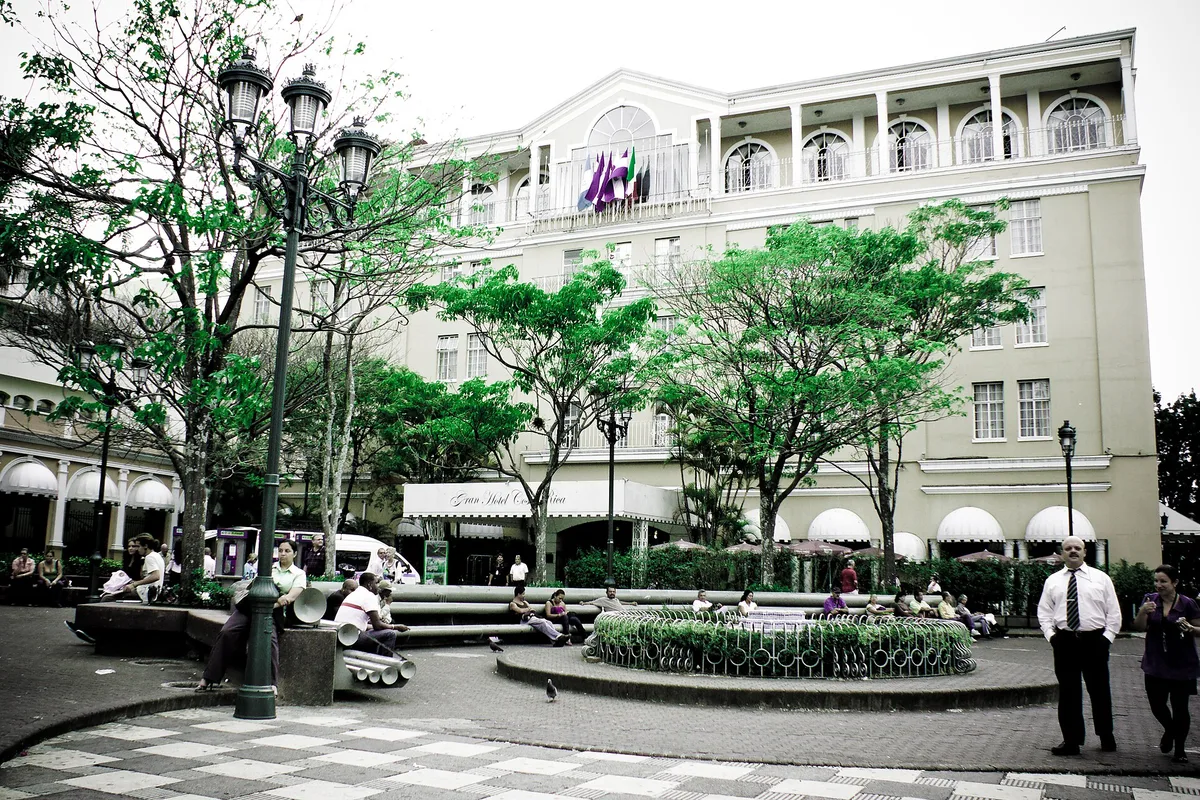
Gran Hotel Costa Rica, Curio Collection by Hilton.
Best for the landmark splurge — the 1930 hotel facing the National Theatre and Plaza de la CulturaSleep in the 1930 landmark on Avenida Central, facing the National Theatre and Plaza de la Cultura — 79 rooms in a declared historic monument, a restaurant and piano bar downstairs, and the Gold Museum under the plaza outside. Book it for the fullest version of downtown San José.

Hotel Presidente.
Best for a central mid-range base on the Avenida Central boulevard, rooftop bar upstairsStay on Avenida Central at Calle 7, in the thick of the pedestrian boulevard — a family-run hotel with a colourful mural facade, the Azotea Calle 7 rooftop restaurant and bar, and the museums minutes on foot. Book it for a central base with local character.
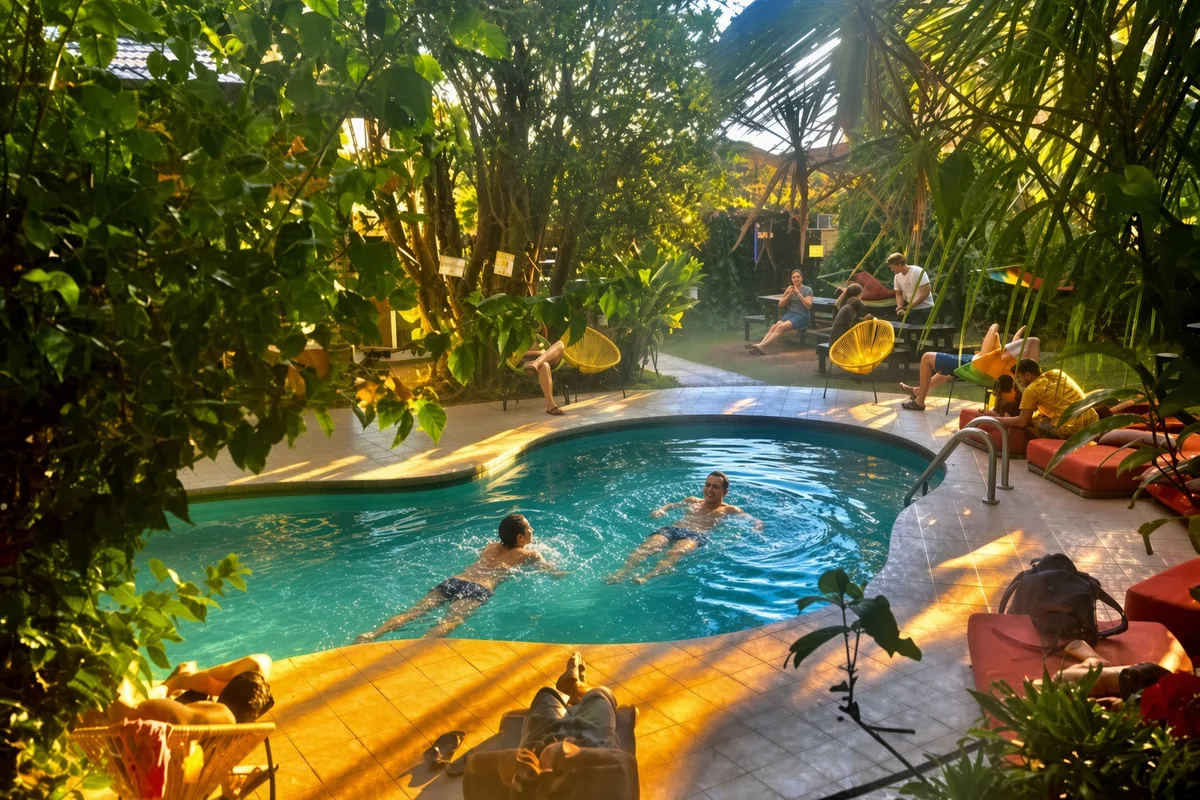
Costa Rica Backpackers.
Best for budget beds with a pool — dorms and privates around a tropical garden, kitchen and barBed down on Avenida 6, Calles 21 to 25, east of the centre near the Atlántico station — the city's original backpacker hostel, running since 2001, with dorms and private rooms around a tropical garden, a pool, a guest kitchen and a bar. Book it for the social version of budget San José.
Base in the centre on a first visit — the museums, the market and the bus terminals sit within walking distance, and day trips pick up from downtown hotels. Paseo Colón and La Sabana, west of the centre, are calmer and greener. Escazú, the expat suburb in the western hills, has malls and international restaurants but needs a ride for everything.
Book ahead for December to April, when dry-season demand fills the good rooms. Confirm whether the quoted rate includes the 13% VAT before comparing prices.
Where to eat first

Eat like a tico on day one. Breakfast is gallo pinto — rice and beans refried with onion, pepper and Salsa Lizano, with eggs, natilla and coffee. Lunch is the casado: rice, beans, salad, sweet plantains and a protein, different at every soda. Coffee is serious here — order it chorreado, dripped through a cloth filter. Three first stops:
Mercado Central, Avenida Central at Calle 6.
Eat at the soda counters inside the 1880 market block — casados, olla de carne beef soup and fresh jugos, then a sorbetera cinnamon ice cream from the stall serving it for over a century. Arrive at lunch and follow the crowds.
Restaurante Nuestra Tierra, Avenida 2 facing Plaza de la Democracia.
Eat the traditional Costa Rican table — parrillada grills to share, arroz con pollo, chicharrones — in a big, lively room by the National Museum. A first-night feast; portions are built for sharing.
Tin Jo, Calle 11 between Avenidas 6 and 8.
Eat the city's beloved pan-Asian dinner — Thai, Japanese, Indian and Chinese dishes in themed rooms in an old house south of the centre. Book it for a break from rice and beans at a local institution.
For food tours and market walks, browse the San José listings on GetYourGuide.
Day trips and more
Three escapes cover the volcano country at three speeds: the crater classic, the long Arenal run and the highest summit in the country. Carry a warm layer — the summits sit above 2,700 metres and the weather turns fast.

Poás Volcano, La Paz Waterfall and a coffee farm
One day north into the hills: the vast main crater of Poás, the 37-metre La Paz Waterfall, and a working coffee farm for the process and a tasting. Pickup and lunch included, rated 4.7, from about US$139. Check availability →

Arenal Volcano, waterfalls, coffee and hot springs
Fourteen hours on a back-road route to La Fortuna: a coffee stop, the La Paz and San Fernando waterfalls, lunch at the foot of Arenal's cone, a Maleku indigenous presentation, and an afternoon in the Paradise Hot Springs before dinner. From about US$165. Check availability →

Irazú Volcano, Cartago and the Orosi Valley
Eight hours up to 3,432 metres, the highest active volcano in Costa Rica: walk the ash plain between its craters, descend to Cartago's Basilica of Our Lady of the Angels, and lunch in the Orosi Valley by a colonial church. Rated 4.6, from about US$135. Check availability →
Leave a spare day for La Fortuna or the Pacific — Manuel Antonio is a long day trip and a better overnight.
When to go and what it costs

December to April is the dry season: blue mornings, clear volcano views and the city at its easiest — January to March is the sweet spot. May to November is the green season: mornings are often fine, rain arrives most afternoons, and September and October are honestly the rainiest months, with daily downpours and the lowest prices. At 1,150 metres the city never gets hot: 23 to 26°C by day, a layer at night.
Budget in dollars and pay in colones at about CRC 500 to US$1 (October 2026). The TUASA bus is about US$1.45; a casado lunch US$8 to 12; museum entry roughly US$10 to 20; a cross-town Uber a few dollars.
A backpacker in a dorm, on soda lunches and buses: US$35 to 50 a day. Mid-range — a good downtown room, restaurant dinners, a volcano day: US$100 to 150 a day. A splurge day with the Gran Hotel passes US$300.
What to pack
Tap items to check them off — your list is saved on this device.
Pack for eternal spring plus a tropical downpour — both can arrive before lunch, and the volcano summits are genuinely cold. This is the full list:
- Comfortable walking shoes Shop walking shoes on Amazon →
- Sunscreen Shop sunscreen on Amazon →
- Reusable water bottle Shop water bottle on Amazon →
- Phone charger and power bank Shop power bank on Amazon →
- Daypack Shop daypack on Amazon →
- Sunglasses Shop sunglasses on Amazon →
- Light rain jacket Shop rain jacket on Amazon →
Add the San José extras: a warm fleece for Poás and Irazú mornings, an umbrella in the green season, and shoes with grip — sidewalks and market floors get slick in the rain. No adapter needed for US plugs.
Language, visa and entry
✓ Visa-free entry

Spanish runs the city, warmly — ticos greet first and close conversations with pura vida, the national phrase that means hello, thanks, all good and goodbye in one. English works in hotels, tour offices and the airport, and thins out at soda counters, where the phrases below do the work.
Four phrases do most of the work:
Sort your entry paperwork before you book anything non-refundable. US, Canadian, British, EU, Australian and New Zealand passport holders enter visa-free, the officer granting up to 180 days on arrival — the stamp, not the maximum, is your real limit, so check the days you are given.
The onward ticket is not a formality: Costa Rica requires proof of travel out of the country within your permitted stay, airlines check it before boarding, and immigration can ask again on arrival. You may also be asked for means of support — about US$100 per month of stay. A yellow fever certificate is required only if you arrive from a risk country.
Safety and health
Keep your phone low-profile downtown
The common crimes are pickpocketing around the Central Market and the bus terminals, and bag snatching from café tables. Keep the phone in a pocket between uses, wear the daypack in front in the market crush, and use the hotel safe for passports.
Ride after dark, walk by day
The centre, Barrio Amón and Escalante are busy in daylight. After dark the downtown grid empties — take a metered red taxi or an Uber between dinner and your hotel rather than walking quiet blocks.
Agree the taxi rules before you ride
Airport taxis are orange; city taxis are red and must run the meter, called the maría. If the meter is broken, agree the fare before the door closes or take the next cab. Uber quotes the price upfront.
Respect the rain and the altitude
Green-season afternoons flood streets fast — plan walks for the morning and carry the rain jacket from May to November. On volcano days the summits pass 2,700 metres: take water, sunscreen and a warm layer. For anything serious, dial 911.
Related destinations
If you liked San José, Costa Rica, try these next:
 The Americas
 The Americas
 The Americas
 The Americas
 The Americas
 The Americas
 The Americas
 The Americas
 The Americas
 The Americas
Frequently asked questions
The arrival, the onward ticket and the taxes, in short.
Fares checked against SJO and TUASA reporting and 2025 to 2026 fare trackers, October 2026; entry rules against Costa Rica Tourism Board and 2026 consular guidance.
TUASA bus from in front of the terminal: about CRC 730, 45 minutes downtown. Orange airport taxis run the meter, about US$30; Uber about US$15.
US, Canadian, British, EU, Australian and New Zealand passport holders enter visa-free, up to 180 days set on arrival. An onward ticket is required and checked.
The centre for a first visit — museums, market and day-trip pickups on foot. Paseo Colón and La Sabana are calmer; Escazú is a car-based suburb.
None per night. Lodging carries 13% VAT, and the US$29 departure tax is inside most air tickets — if your fare excludes it, you pay at the airport.
December to April, the dry season; January to March is driest, with the clearest volcano views. September and October are the wettest months.
With normal city care, yes. Watch pickpockets around the market and bus terminals, keep phones put away, and ride rather than walk downtown after dark.
Fares change — TUASA, the airport taxi rank and your ride app always win.
San José, Costa Rica, in your pocket
Landing soon? Get the printable PDF — ticket links, the airport transport cheat sheet, our 3 restaurant picks with maps, and the packing checklist. Everything above, formatted for your phone.
One email with your San José, Costa Rica PDF. Fare changes and new guides after that. No spam, unsubscribe anytime.
Sources and last verified
Airport transfers against SJO and TUASA reporting and 2025 to 2026 fare trackers: TUASA about CRC 730 (CRC 720 to 735 across sources), orange taxis metered at about US$30, Uber about half that; distance 17 km from Alajuela. Entry against Costa Rica Tourism Board and 2026 consular guidance: Group 1 nationals, including US passport holders, visa-free up to 180 days at the officer's discretion, onward ticket required and checked, funds about US$100 per month. Taxes: 13% VAT on lodging, no per-night city tax; the US$29 departure tax is included in most air tickets — travellers whose fare excludes it pay at the airport. GetYourGuide hub opened and verified as San José, Costa Rica (l379); the Poás, Arenal and Irazú product pages were opened and read, prices as listed October 2026. Expedia returned HTTP 429 during this build, so hotel URLs are empty pending the confirmation pass. Photo credits as in the guide data. Last verified October 2026.
Affiliate disclosure: hotel names, transfers, experiences, and products linked in this guide may earn After You Land a commission at no extra cost to you. Prices and times were checked in Oct 2026 and change often — confirm before you book.